Personas: Giving Your Site More Than One Writer
Up to four writers per site: beats, rotation weights, the two-in-a-row guard, when the writer is decided, and how to write voices that sound different.
Updated Aug 26, 2026 · 10 min read
You can tell when a blog has one author. Not from the byline, from the rhythm: forty posts that all warm up the same way, all reach for the same kind of transition, all end on the same shrug.
Personas fix that by giving your site an actual staff.
Brand Voice introduces them in a paragraph. This page is the full manual: how assignment really works, what the rotation weights do, why one writer sometimes takes three articles in a row, and where the feature quietly stops.
Where they live
Site Settings, the Personas tab. Up to four per site, and the counter in the card header tells you where you are (3/4 in the shot below).
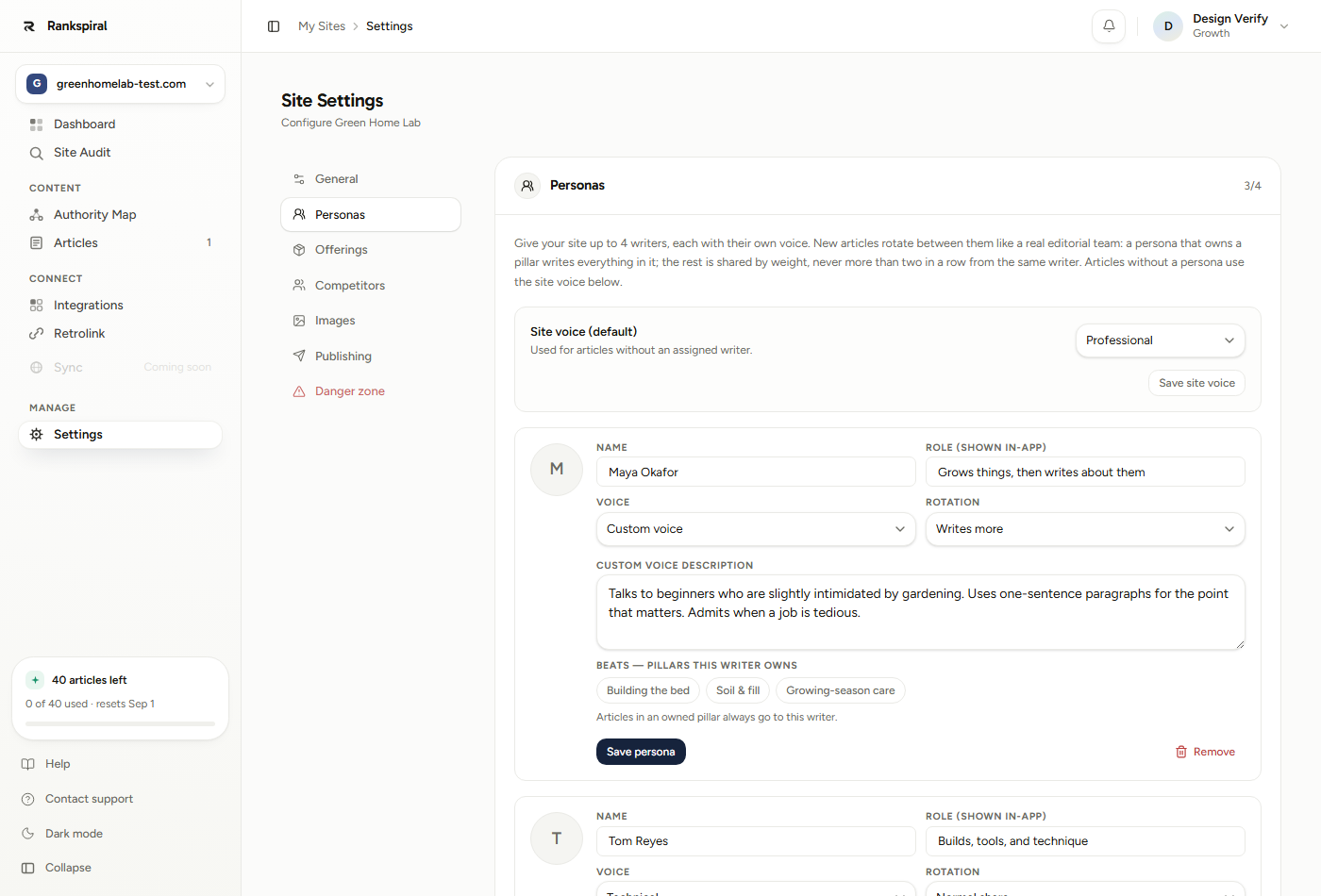
The tab needs the custom voice capability, which means Growth, Portfolio, Agency and the trial. On Starter the card renders blurred behind a lock reading "Writer personas, Growth plan and up".
The site voice sits at the top of the same tab. That is the default every article uses when no persona is assigned, and it moved here so all voice settings live in one place. A site with zero personas behaves exactly as it always did.
What a persona is made of
Six fields, and only one of them is required.
| Field | What it does | Notes |
|---|---|---|
| Name | The writer's identity in the app | Required, 60 characters max. A random plausible name is generated for you when you add a persona |
| Role (shown in-app) | A short descriptor under the name | Optional, 80 characters. Never sent to your CMS |
| Avatar | The circular face on the card and on article headers | One of four bundled portraits is dealt automatically. Click it to upload your own (images only, under 2 MB). Save the persona first |
| Voice | One of the six tone presets, or Custom voice | Choosing Custom voice reveals the description box below it |
| Custom voice description | Free text describing how this writer sounds | Up to 6,000 characters. This is where the feature earns its keep |
| Rotation | How much of the unowned work this persona takes | Writes less, Normal share, or Writes more |
| Beats | Pillars this writer owns outright | Chips, one per pillar in your Authority Map. Up to 20 |
Each persona card saves on its own with Save persona. There is no page-level save, so a half-finished second writer will not block the first from going live.
Beats: who owns what
A beat is topic ownership, exactly like a real editorial desk. Assign a persona to a pillar and every article in that pillar goes to them.
The chain runs keyword to cluster to pillar to persona. So beats only apply to articles created from a keyword that sits in a cluster that sits in a pillar. An ad-hoc article typed in by hand has no pillar, so it falls through to rotation.
- Nobody owns the pillar and the article goes to weighted rotation, which is the normal case for most sites.
- Two personas own the same pillar and the article goes to a weighted pick between just those two. Nothing stops overlapping ownership, and it is occasionally what you want.
- One persona owns a busy pillar and they will write everything in it, back to back, for as long as the queue stays in that pillar. Beats deliberately bypass the anti-streak guard.
That last one is the single most common "is this broken" question about personas. It is the beats rule doing its job.
Rotation: who takes the rest
Everything without an owner is dealt out by weight. The three options are not labels on a scale, they are literal multipliers.
| Setting | Relative share | Use it for |
|---|---|---|
| Writes less | 1 | A specialist you want on their beat and almost nowhere else |
| Normal share | 2 | The default, and correct for most writers |
| Writes more | 4 | Your house voice, the one readers should meet most often |
So a Writes more persona takes four times the unowned articles of a Writes less one, and twice as many as a Normal share one. The pick is genuinely random inside those weights, not a round robin, so short runs will look lumpier than the ratio suggests.
The two-in-a-row guard
Before each pick, RankSpiral looks at the two most recently created articles on the site that have a writer assigned. If both belong to the same persona, that persona is dropped from the pool for this one article.
Which produces exactly the rule you want: no persona ever writes three in a row, unless a beat put them there.
Three details worth knowing, because they explain the exceptions:
- The window is site-wide, not per pillar or per cluster. Two consecutive articles anywhere on the site count.
- It looks at creation order, not publish order. A batch queued at once is ordered by when each row was created, so your blog index may show a different sequence.
- Beat-assigned articles count toward the streak but ignore it. They set the writer before the guard runs, so a pillar owner can legitimately go on a run.
When the writer is decided
Once, at the moment the article row is created. Never again.
That is a design decision with a real payoff: retries, regenerations, style passes and image redos all read the same stored writer, so an article cannot change author halfway through. It also means personas created today do not retroactively claim yesterday's drafts.
You can override it by hand, but only before the article has content. The writer chip sits in the article header, next to the stage strip.

Open the chip and you get every persona plus a Site voice entry that clears the assignment entirely. Once writing has produced content the chip goes read-only, and the toolbar shows the writer's avatar, name and role instead.
Inline AI edits follow the persona too. Highlight a paragraph in the editor and ask for a rewrite, and the request carries the same writer's voice the pipeline used. An article stays in one voice even when you edit it by hand.
Writing voices that are actually different
Four personas with four tone presets will produce four articles that sound broadly the same, because presets are broad by design. The difference comes from custom descriptions, and specifically from behaviors rather than adjectives.
The trick that makes a roster work is contrast. Do not write four good voices, write four voices that disagree about something. Here is a roster that reliably produces distinguishable output on a gardening site:
The practitioner. Talks to beginners who are slightly intimidated. Leads with the payoff before the explanation. Short sentences. Admits when a job is tedious instead of pretending it is fun. Real numbers, never "a while". Never uses the words simply, just, or easy.
The sceptic. Opens with the objection, not the pitch. Names the trade-off in every recommendation. Uses one dry aside per section, never two. Will say "this is probably not worth it for most people" when it is true.
Read those two aloud and you can hear the difference. That is the bar.
Behaviors worth stealing into any persona description:
- Give it one thing it refuses to do. "Never opens with a question." "Never uses the word leverage." A prohibition shapes voice faster than any positive instruction.
- Give it a sentence-length habit. "Short sentences. One long one per section, for the idea that needs room."
- Give it a relationship to the reader. "Assumes the reader has already tried the obvious thing and it did not work."
- Give it one tic. "Uses ellipses when weighing options... like thinking out loud." One per writer. Two tics is a costume.
- Say who it is not. "Not a salesperson. Will name the cheaper alternative."
Two or three behaviors per persona. Not ten.
Getting the most out of a roster
Start with two, not four. A specialist who owns your money pillar on Writes more, and a generalist on Normal share for everything else. Two voices is already enough to break the one-author smell, and four half-thought voices read worse than one good one.
Put yourself in as the pillar owner. Write your own voice description for the topic you genuinely know best, assign yourself that beat, and let the other writers carry the supporting content. It scales the credibility you actually have instead of inventing new ones.
Add a third only when you publish a second content shape. Comparisons and reviews want someone blunter than a how-to writer. If everything you publish is how-to guides, a third persona is decoration.
Test them the honest way. Generate one article per persona from similar keywords, strip the titles, and read the first two paragraphs of each out loud. If you cannot tell them apart, your descriptions are adjectives, not behaviors. Rewrite the weakest one and try again.
Leave beats empty for the first month. Pure rotation across two personas gives you a faster read on which voice is working. Add ownership once you know which writer you want on your most valuable pillar.
You will know it is working when you open two articles from different pillars and can tell, inside a paragraph, that different people wrote them... without checking who.
Where personas stop
Being clear about this saves a support ticket later.
- Personas are in-app only. The name, role and avatar are never sent to your CMS. WordPress, Shopify, Webflow, Framer and the webhook payload all carry no author information, so nothing appears as a byline on your published site.
- Research and outline stages use the site voice. The persona voice enters at the writing stages, so a re-run of research or outline generation does not carry it.
- A persona voice replaces the site voice rather than blending with it. Assign a persona with a preset tone and the site's custom voice description does not leak through. That is intentional, but it means a preset-tone persona is a genuinely blanker slate than you might expect.
- There is no on/off switch. To stop using personas, delete them. Deleting is safe: existing articles keep their content and simply fall back to the site voice for any future passes.
- Downgrading to Starter does not stop assignment. The settings card locks so you cannot create or edit writers, but existing personas keep being assigned to new articles. Delete them if you want the site voice back.
If it is not behaving
- One persona is writing everything. Check its beats. If it owns the pillar your queue is currently working through, that is the rule, not a bug. Clear the beat or queue from a different pillar.
- New personas are not showing up on articles. Assignment happens at creation, so only articles created after the persona existed get it. Existing drafts keep the writer they started with.
- The writer chip is not clickable. The article already has content. Assignment locks once writing has produced a draft.
- "Save the persona first, then add an avatar." Avatar upload needs a saved persona to attach to. Click Create persona, then the avatar circle.
- The Beats chips are missing. The site has no pillars yet. Build your Authority Map first and the chips appear.
- All four articles this week came from two writers. Weighted random is genuinely random. Over four articles that is normal variance; over forty it will not be.
A roster is not a gimmick. It is the cheapest way to make a site read like people work there, which is increasingly the only thing that separates a blog from a content farm.
Two writers, two real descriptions, fifteen minutes. Then it runs on its own.
Brand Voice: tone presets and writing a voice→ Pillars and clusters, which is what beats attach to→ Inline AI editing, which follows the persona voice→ How an article is generated, stage by stage→Was this page useful?
Tell us what was missing and we'll fix the page.