Keyword Clusters and Pillars, Explained
What keyword clusters and pillar pages are, in plain language, why they decide what ranks, and how to group keywords the way Google already does.
Updated Aug 26, 2026 · 5 min read
What is a keyword cluster, what is a pillar page, and why does every serious SEO strategy organize itself around them? Plain-language answers, one running example, no jargon you have not been given first.
The plain-language definition
A keyword is anything someone types into a search engine: "how to descale an espresso machine" is a keyword, and so is "descaling espresso machine with vinegar".
Here is the thing search engines figured out years ago: those two searches want the same answer. Google does not want two different pages for them; it ranks one good page for both. A keyword cluster is a group of keywords so close in meaning and intent that one page can satisfy all of them.
Run with a concrete example: you sell espresso gear and write about coffee. Around the topic of cleaning machines, real searches include:
- "how to descale an espresso machine"
- "descale espresso machine with vinegar"
- "how often should I descale my espresso machine"
That is one cluster. One thorough article about descaling, with a section on vinegar versus commercial descaler and a section on frequency, can rank for all three. Writing three separate posts would be doing Google's job worse than Google does it.
A pillar is the level above: the broad topic that many clusters belong to. "Espresso machine maintenance" is a pillar; descaling is one cluster inside it, alongside clusters for backflushing, replacing gaskets, and water filters. The pillar page covers the whole topic at survey depth and links down to each cluster article; the cluster articles link back up. That linked structure is often called hub and spoke, and the shape matters as much as the words: it tells search engines these pages belong together and which one is the summary.
Why it matters
Get clustering wrong in either direction and you pay for it:
- Too many pages (one page per keyword) and you get thin articles competing with each other for the same search. Google has to pick one of your near-duplicates, splits signals like links and clicks between them, and often ranks none of them well. SEOs call this cannibalization, and it is the most common failure mode of "publish more content" strategies.
- Too few pages (one mega-article for a whole pillar) and you lose to specialists. Your 6,000-word "everything about espresso machines" page will be outranked for "descale espresso machine" by a focused page that answers exactly that.
A believable before-and-after: a coffee blog publishes ten short posts, each chasing one descaling phrase. None cracks the top 20. They consolidate into one strong descaling guide and redirect the rest, and that single page ranks for dozens of phrasings of the question, because every signal now points at one asset. Same total effort, opposite outcome. The grouping was the strategy.
Pillars add the long game: when your descaling article, your water filter article, and your gasket article all sit under a coherent maintenance pillar, each new article makes the others a little more credible on the topic. That accumulated credibility is what SEOs mean by topical authority, and it is why sites with organized clusters outrank bigger sites with scattered content.
How this works in RankSpiral
This is the concept the Authority Map is built on. When RankSpiral maps your niche, it does not produce a flat keyword list; it builds the full hierarchy of pillars, clusters, and keywords, so every article you generate already knows which cluster it serves and which pillar it supports.
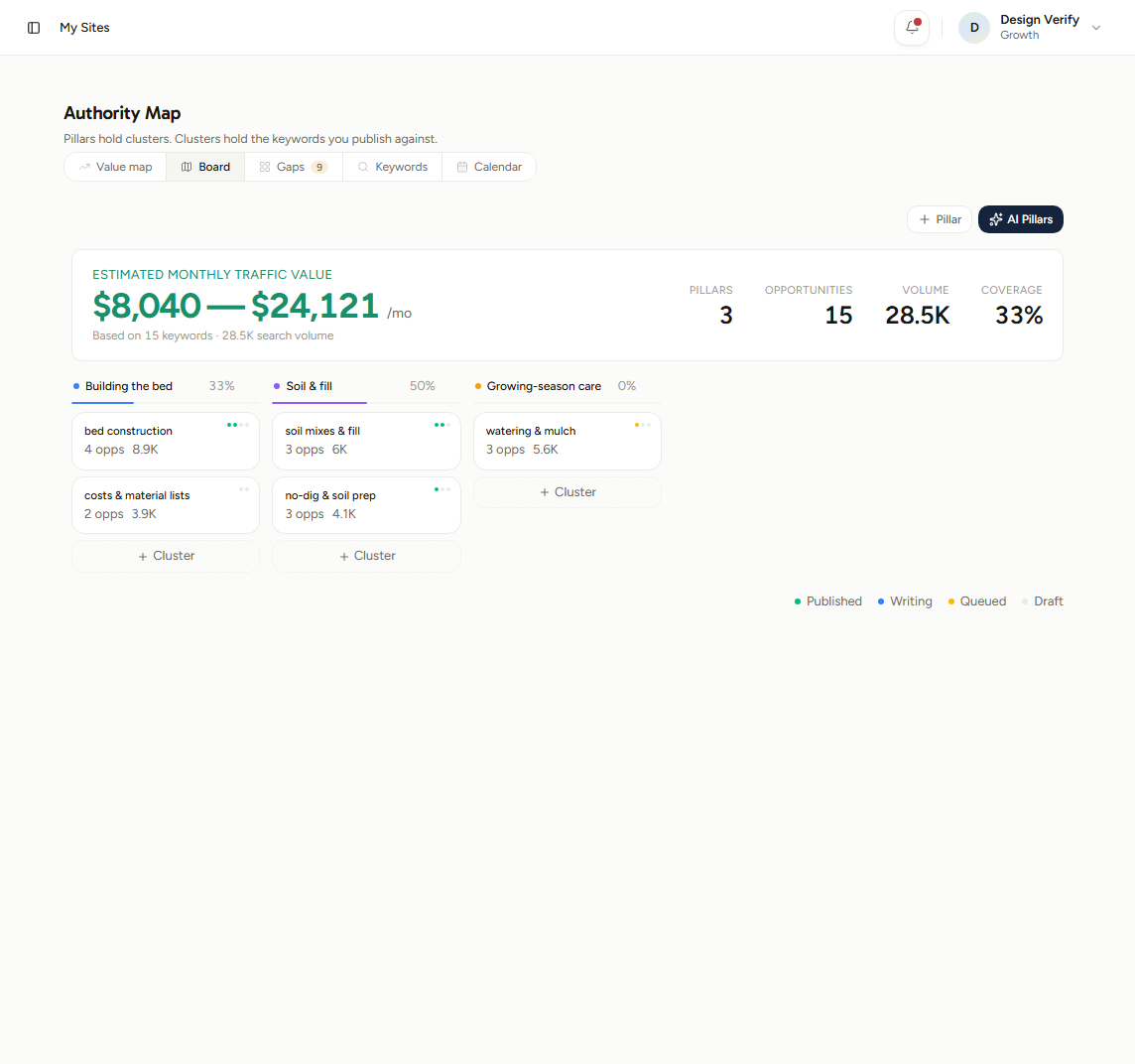
The part worth knowing: cluster boundaries are decided by evidence, not vibes. Two keywords look related when the words look similar, but the reliable test is what Google actually does: if two searches return mostly the same top-ranking pages, one article can win both; if the results barely overlap, they need separate articles. RankSpiral checks real search results for your keywords and groups them the way the rankings already group them, rather than letting a language model guess from wording alone.
The concept stands on its own. If you never use the product, you can do a rough version by hand: search your two candidate keywords and compare the top ten results. Big overlap means one article; little overlap means two.
Going deeper
- Clusters are about intent, not synonyms - "best descaling solution" contains the same topic words as your how-to cluster, but the searcher is shopping, not fixing. Commercial and informational intent almost always deserve separate pages, even when the vocabulary is identical.
- Some keywords are their own cluster - a high-volume head term like "espresso machine" can justify a dedicated page even though it technically belongs to a pillar. Volume and competition can promote a keyword to its own asset.
- Cluster boundaries drift - Google re-groups queries as behavior changes; two keywords that shared results last year may split as intent diverges. Clustering is a snapshot, which is one reason to re-check rankings rather than treat an old keyword map as permanent truth.
- Tiny niches break the standard advice - if your whole field only has a handful of distinct intents, a single excellent pillar page plus three or four cluster articles can be the entire correct strategy. Do not manufacture clusters to feel productive.
The myth to unlearn: more pages means more traffic. Pages that do not map to a distinct cluster do not add traffic; they dilute it. The right number of articles is the number of distinct intents in your niche, not the biggest number you can afford.
To see the concept applied to your own niche, the feature docs cover how the map gets built and what to write first:
Topical Map→ How to Use the Authority Map→Was this page useful?
Tell us what was missing and we'll fix the page.