Brand Voice
How to make articles sound like you wrote them: tone presets, writing a voice that actually works, and giving your site up to four writers.
Updated Aug 26, 2026 · 7 min read
Most AI writing has a smell. Not bad exactly, just... beige. Technically fine sentences that could have come from anyone, about anything.
Brand voice is how you get rid of that smell.
This page covers the two levers you have: a voice (how your site sounds) and personas (who is doing the writing). The first one takes two minutes. The second is what makes a blog feel like it has actual humans behind it.
Start with tone, not adjectives
Every site picks one of six tone presets in Settings → Content. They are not decoration. Each preset is a full set of writing instructions that ships with your articles, covering sentence rhythm, formatting habits, and a list of things the writer must never do.
Here is the entire list, with what each one is actually good at:
- Professional - clear and direct, alternates short punchy statements with longer explanations. The safe default for B2B and services.
- Conversational - written like you are explaining something to a smart friend over coffee. Short sentences dominate. Best for anything a beginner might land on.
- Technical - leads with the conclusion, then supports it. Defines terms inline, never hand-waves. Right for developer and specialist audiences.
- Casual - relaxed, uses fragments, occasionally playful. Good for lifestyle, hobby, and DTC brands.
- Authoritative - declarative, expert-level depth. One-sentence paragraphs for verdicts.
- Witty - clever without trying too hard, with the personality dialed up a notch.
Pick the one closest to how you already talk to customers. You can change it any time, and it only affects articles generated after the change.
Not sure? Start with Conversational. It is the hardest tone to make boring, and it reads well to both people and AI search engines, which increasingly quote content that sounds like a person answering a question.
Then write an actual voice
Presets are a shortcut. On Growth and up, you can replace the preset with a custom voice description, which is a free-text field where you describe exactly how your content should sound.
This is where most people go wrong.
They write adjectives. "Professional but friendly, engaging, and authoritative" tells the writer almost nothing, because every one of those words means something different to everyone. What works instead is behaviors: specific, checkable instructions a stranger could follow.
Compare these two. The first is what people usually write, the second is what actually changes the output:
Professional but approachable. Engaging and informative. Speaks with authority while remaining friendly and accessible to our audience.
Talk to small business owners who are new to SEO and slightly suspicious of it. Use "you" constantly, "we" sparingly. Lead every section with the practical payoff before any explanation. Short sentences. Real numbers instead of vague claims ("adds about 20 minutes" not "takes a while"). Admit when something is tedious rather than pretending it is exciting. Never use the words leverage, robust, or seamless.
The second one is longer, sure. It is also impossible to misread.
Behaviors worth stealing
These are lines you can paste into your voice description and adjust. Each one changes something concrete about how the writing lands:
- "Be witty once per section, never twice." Humor works as seasoning. Twice in a paragraph and it becomes the point.
- "Break the fourth wall when a topic gets dry." Something like "yes, we are really talking about sitemap files, stay with me" buys you another two paragraphs of attention.
- "Use ellipses when weighing options... like you are thinking out loud." It slows the reader down at exactly the moment you want them thinking.
- "Open with the objection, not the pitch." Starting at "this sounds like a lot of work" earns more trust than starting at "here is why this is great".
- "Use one-sentence paragraphs for the point that matters." Nothing else on the page gets that kind of emphasis.
- "Prefer concrete nouns. A shop, a spreadsheet, a Tuesday." Abstraction is where voice goes to die.
Pick two or three. Not ten.
Then generate one article and read it out loud. You will hear immediately which behavior sounds like your brand and which one is a costume.
The most common mistake: describing your company instead of your writing. "We are a customer-obsessed team building tools for modern marketers" is an About page, not a voice. The writer cannot act on it.
Give the site more than one writer
Real blogs have several people writing them. You can tell, even when the bylines are missing, because a how-to guide reads differently from a product comparison.
Personas recreate that. Each site can have up to four, on Growth and up, and each one is a small identity: a name, an optional role, an avatar, and its own voice, either a preset tone or a full custom description.
They live in Settings → Personas.
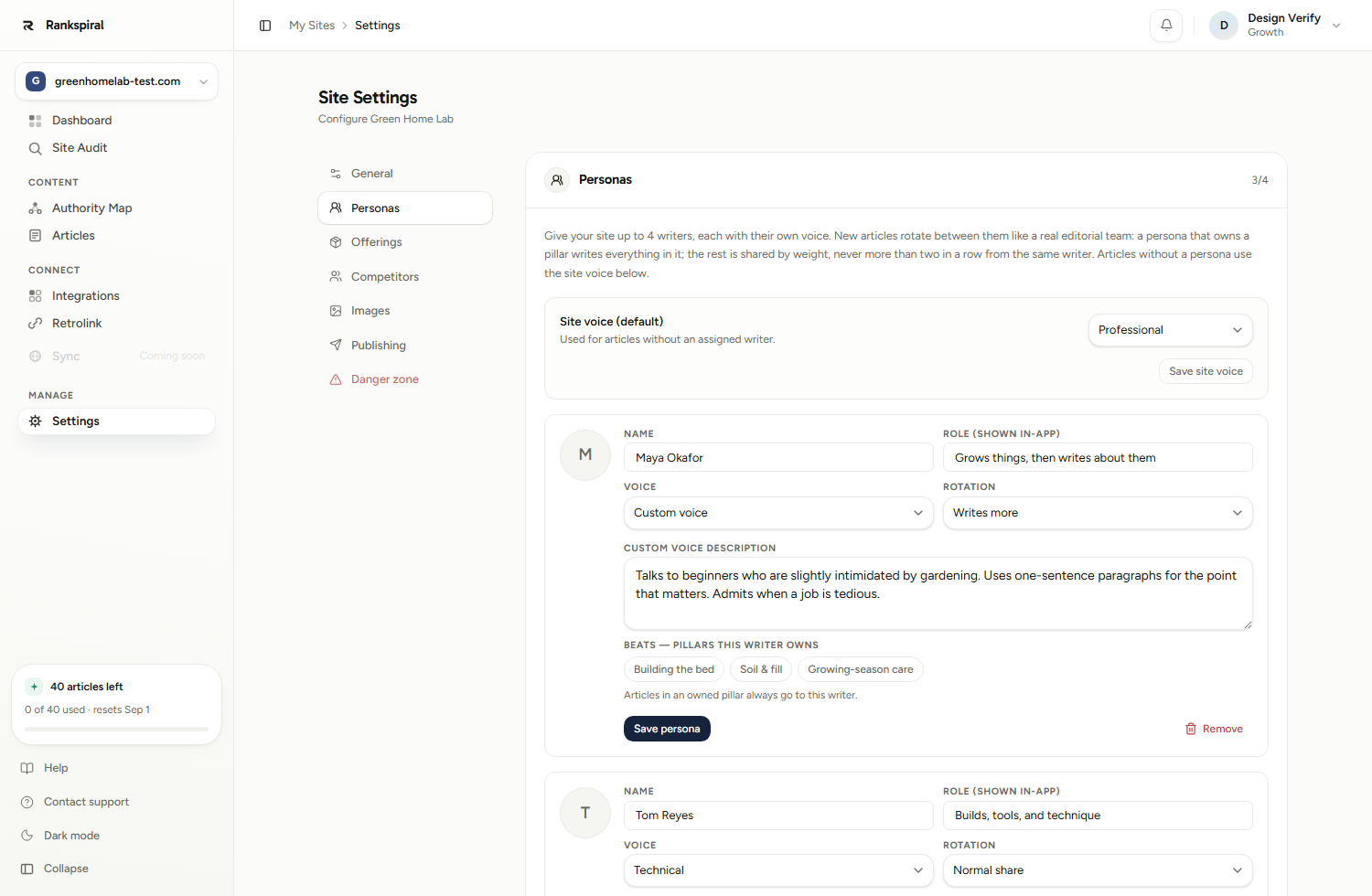
Two settings decide who writes what:
- Beats - assign a persona to one or more pillars from your authority map, and that persona writes everything in them. Topic ownership, exactly like a real editorial team, with the side benefit that a whole cluster stays in one voice.
- Share - for everything nobody owns, articles are handed out by weight: Writes less, Normal share, or Writes more. A guard stops any persona from taking more than two in a row, so your blog index never reads like one person on a spree.
Assignment happens once, when the article is created. It sticks through retries and edits, so a piece never changes author halfway through.
Why bother with more than one
Three reasons, in the order they usually matter.
Different content wants different voices. A comparison post benefits from someone blunt and opinionated. A beginner guide wants someone patient. One voice doing both does neither especially well.
Variety reads as a real publication. Forty articles in one identical register is the single loudest tell that a blog is automated. Rotation breaks the pattern without you writing a word.
It scales your own credibility. Put yourself in as the persona who owns the pillar you actually know best, and let the other writers handle the supporting content.
A setup that works well for most sites: one specialist who owns your money pillar and writes more, one generalist on normal share for everything else, and if you publish comparisons or reviews, a third with a blunter voice for those.
You will know it is working when you can open two articles from different pillars and tell, in one paragraph, that different people wrote them... without checking the byline.
Everything else the writer knows about you
Voice decides how articles sound. Three other settings decide what they can talk about, and they matter more than they look.
- Offerings - your products and services, each with a name, URL, and description. They sharpen keyword suggestions, keep articles anchored to what you actually sell, and give the link stage somewhere real to point.
- Competitors - add the ones you know. Research uses them for angles and gaps. Leave it empty and they get discovered automatically, usually correctly, occasionally not.
- Image style - a preset (flat minimal, photorealistic, illustrated, dark cinematic, watercolor), a custom prompt, or a reference image to match. Visual consistency does the same job for your brand that voice does for your text.
Offerings are the one people skip. Do not skip offerings. An article that knows what you sell links naturally to it, and that link is the entire point of the exercise.
If the voice is not landing
- Articles still sound generic. Your description is probably adjectives. Rewrite it as behaviors, with at least one instruction about sentence length and one about what to never say.
- Voice is right, facts feel thin. That is a research problem, not a voice problem. Check your offerings and competitors first.
- Personas are set but articles ignore them. Only articles created after the persona existed get assigned. Existing drafts keep the writer they started with.
- One persona is writing everything. Check the beats: if it owns the pillar your queue is currently working through, that is the beats rule doing its job, not a bug.
One last thing worth saying plainly.
Voice is the cheapest quality lever in the product. Fifteen minutes writing a real description, once, changes every article you generate from then on... which is a better return than almost anything else you could spend that quarter hour on.
Was this page useful?
Tell us what was missing and we'll fix the page.