Writing a Brand Voice Prompt That Changes the Output
A workshop: one weak voice description rewritten in three passes, how to test a voice in twenty minutes, and the word lists that do the most work.
Updated Aug 26, 2026 · 9 min read
You read the advice, opened the field, and wrote four sentences about how your brand sounds. The articles came back... fine. Slightly less beige than before, and still not yours.
That is the normal outcome of a first draft, and the fix is not a better first draft. It is a second and third one.
This page is a workshop. One real, weak voice description, rewritten in three passes, with the specific edits that moved it and a twenty-minute test you can run afterwards.
Before you start: a custom voice description is available on Growth and up. On Starter you get the six tone presets, which are genuinely good, and the rest of this page still tells you what to look for when you upgrade.
The one thing to know before you write a word
A custom voice description does not sit on top of your tone preset. It replaces it.
When the field is empty, the writer receives the entire preset: rhythm rules, sentence-length habits, formatting conventions, and a list of things it must never do. The moment you save any custom text, that whole block is swapped out for yours, verbatim.
Two vague sentences do not add personality, they remove instructions. That is why a short custom voice often reads worse than the preset it replaced, and it is the single most common reason people conclude the feature does nothing.
Practical consequence: your description has to carry its own rhythm rules. If it says nothing about sentence length, paragraph length, or formatting, nothing is being said about them at all.
The patient
Here is a real starting point, from a Toronto veterinary telehealth service that runs video consults for cats and dogs.
Professional but friendly and empathetic. We are a trusted, innovative telehealth platform for pet parents. Engaging, informative, and authoritative, while remaining accessible to a general audience.
Thirty words, five adjectives, one company description, and zero instructions a stranger could follow. It would produce almost exactly the same article as no voice at all.
Three passes follow. Each one does a different job, and you can stop after two if the second one lands.
Pass one: turn every adjective into a behavior
The test for a line in your voice description is whether two different people would agree on whether an article obeyed it. "Empathetic" fails that test. "Name the worry before answering the question" passes it.
Go through your draft and convert each adjective into something checkable.
- Empathetic becomes Open every article by naming what the reader is actually worried about, in their words, before explaining anything.
- Accessible becomes Give the plain-English name first and the clinical term in brackets after it, once.
- Authoritative becomes Give a number or a threshold wherever one exists. "Call a vet if it has lasted more than 24 hours", not "if it persists".
- Friendly becomes Use "you" constantly and "we" only when describing what our vets do.
- Professional becomes Never guess. When something needs an in-person exam, say so in one blunt sentence and move on.
Five adjectives, five behaviors, and the description is already doing work.
Notice what happened to "professional" in particular. It turned into a rule about honesty, which is what the word was quietly trying to mean all along.
Pass two: add the constraints, including the word lists
Behaviors decide what the writer does. Constraints decide what it cannot do, and they are the fastest way to remove the machine smell.
Three constraints earn their place in almost every voice description.
A sentence-length rule. Something like Most sentences under 20 words. Vary them: short, then one that runs longer because the idea needs the room, then short again. Uniform sentence length is the loudest tell in AI writing, and it is the cheapest one to fix.
A paragraph rule. Two or three sentences per paragraph. Use a one-sentence paragraph for the point that matters, roughly once per section.
Two word lists. Not one. Banned words remove the smell, preferred words replace it with something.
Never use: leverage, robust, seamless, delve, elevate, unlock, in today's fast-paced world, it's important to note, when it comes to, fur baby.
Use instead: the actual animal ("your cat", "a nine-year-old lab"), the actual symptom, the actual number of hours, the actual cost in Canadian dollars.
The banned list is where most people stop. The preferred list is what stops the writer reaching for the next generic phrase after you took the first one away.
Steal this line verbatim: Prefer concrete nouns over categories. A nine-year-old beagle, a Tuesday evening, forty dollars. Abstraction is where the voice dies. It works for every industry, and it is the single line that changes the most sentences.
Pass three: tell it what to do when the topic gets hard
Every voice holds up over easy material. The third pass is about the paragraphs where it usually collapses: the technical stretch, the boring stretch, and the part where you have to sell something.
Add one line for each.
- Technical - When explaining a condition or a procedure, keep the same short sentences. Do not switch into a textbook register. One analogy, then the facts.
- Boring - When a section is genuinely dull, say so in half a sentence and keep going. Do not manufacture enthusiasm.
- Commercial - Mention the consult only where it is the honest next step. Never end a section with a pitch.
Here is the finished description, at about 220 words. It is longer than the original by a factor of seven and it is impossible to misread.
Write for worried pet owners in Canada, mostly on a phone, mostly at night. Open every article by naming what they are actually worried about, in their words, before explaining anything. Use "you" constantly and "we" only when describing what our vets do.
Plain-English name first, clinical term in brackets after it, once. Give a number or a threshold wherever one exists: "call a vet if it has lasted more than 24 hours", not "if it persists". Never guess. When something needs an in-person exam, say so in one blunt sentence and move on.
Most sentences under 20 words. Vary them: short, then one that runs longer because the idea needs the room, then short again. Two or three sentences per paragraph, with a one-sentence paragraph roughly once per section for the point that matters.
Prefer concrete nouns over categories. A nine-year-old beagle, a Tuesday evening, forty dollars.
Never use: leverage, robust, seamless, delve, elevate, unlock, in today's fast-paced world, it's important to note, when it comes to, fur baby.
When explaining a condition, keep the same short sentences and do not switch into a textbook register. When a section is genuinely dull, say so in half a sentence and keep going. Mention the consult only where it is the honest next step.
The twenty-minute test
Generate one article. Not five.
Then read it out loud, all the way through, and score it against exactly three questions.
- Did you run out of breath anywhere? That is a sentence-length problem, and it means your rhythm rule is not specific enough.
- Did any paragraph sound like a different writer? Mark it. It is almost always a technical or commercial stretch, which is what pass three is for.
- Could you delete your brand name and still tell it was you? If not, your description is still describing your company rather than your writing.
Reading out loud is not a metaphor here. Silent reading forgives rhythm problems that your ear refuses to.
Iterating without going in circles
Change one thing per round, and give it three articles before you judge.
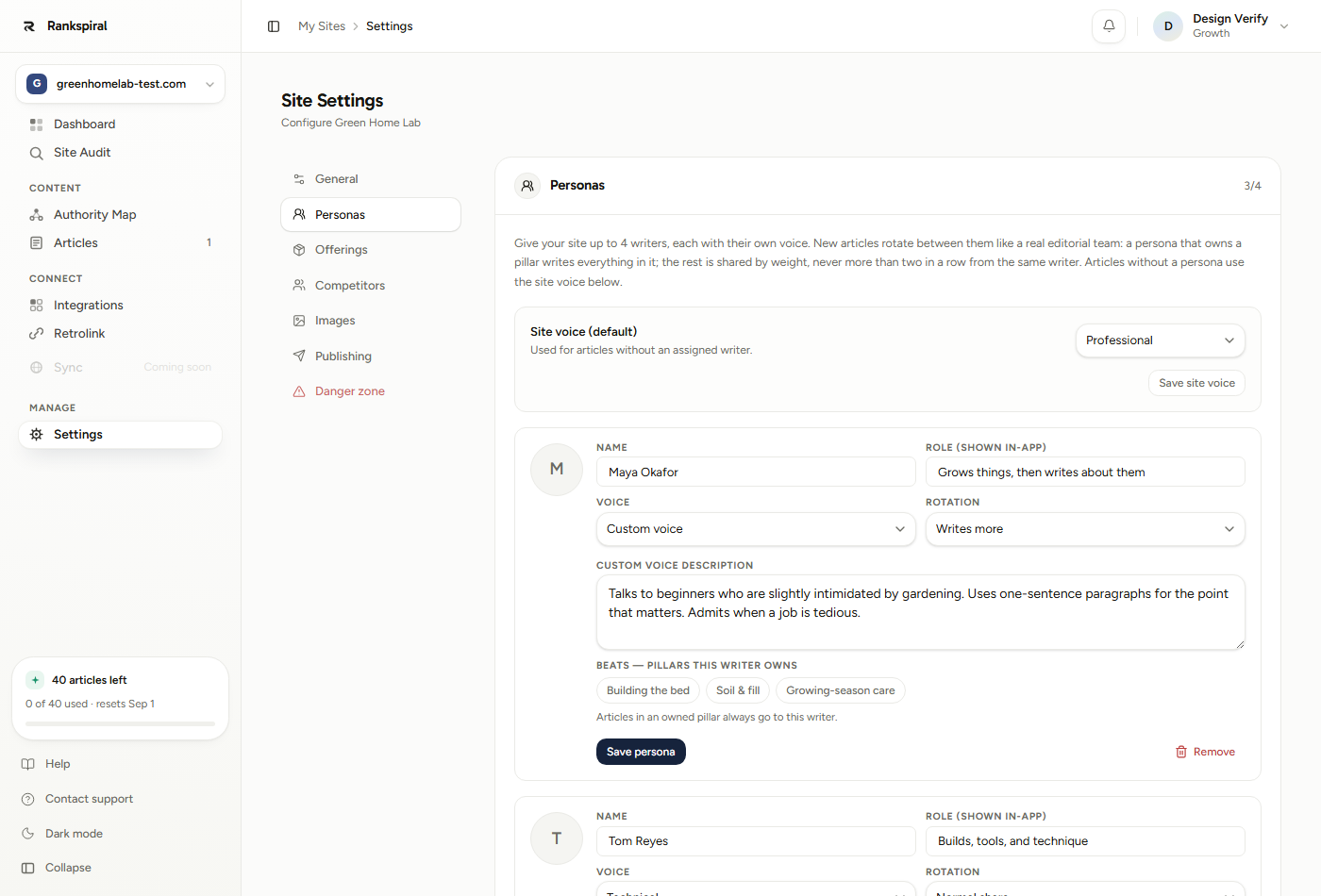
The description lives in two places. Site voice (default) on the Personas tab covers every article without an assigned writer, and each persona has its own Custom voice description box that overrides it. Both save at up to 6,000 characters, which is far more room than you need.
Symptom-driven edits, in the order they usually come up:
- Still generic - your description is under about 80 words. Add pass two.
- Right personality, wrong rhythm - add or tighten the sentence-length line. It is the only lever that reliably changes rhythm.
- Good until it explains something - add the technical line from pass three.
- Trying too hard - you have too many personality behaviors. Cut to two or three and keep the constraints.
- Sounds right, says nothing - that is a research problem, not a voice problem. Fill in Offerings and add competitors.
Inline AI edits inherit whatever you save here, so a voice fix improves every future edit as well as every future article.
The two AI helpers, and where they actually live
RankSpiral can write the first draft of your description for you, from either a short summary or samples of your existing writing.
- Expand into full voice prompt - type at least ten characters describing the tone, click it, and you get back a structured guide covering voice, rhythm, punctuation, how to stay in voice through technical content, and what breaks the voice. It aims for under 500 words.
- Extract my voice - on the From examples tab. Paste at least 100 characters of your own writing, ideally one to three full articles separated by three dashes, and it reverse-engineers the same structured guide. Only the first 12,000 characters are read, so paste your best writing first.
Honest limit worth planning around: both buttons appear only while you are creating a site, not on the Personas tab afterwards. If you want the generated starting point, use it during setup and edit from there. The two buttons also share one budget of five runs per hour.
Treat their output as a pass-one draft, not a finished voice. It is a genuinely good skeleton, and it does not know your banned words, your thresholds, or the thing your customers are actually worried about at 11pm.
You are finished when you can read a paragraph from a new article and predict, before you scroll, roughly how the next sentence will be shaped. That is what a voice is.
Fifteen minutes of adjectives changes nothing.
Fifteen minutes of behaviors, constraints, and two word lists changes every article you generate from then on, which is a strange bargain to keep turning down.
Was this page useful?
Tell us what was missing and we'll fix the page.