Publishing Cadence: How Often Should You Actually Publish?
The honest answer, the arithmetic behind it, and what really happens when you point 21 articles a week at a three-month-old site.
Updated Sep 9, 2026 · 7 min read
Ask ten SEO people how often to publish and you get ten numbers, all of them confident, none of them about your site.
Here is the honest answer, up front: consistency beats volume, and both lose to a cadence you can actually sustain. A site publishing three a week for a year outperforms a site publishing twenty a week for six weeks and then nothing.
This page gives you a number to start with, the arithmetic that produces it, and what actually happens when you point 21 articles a week at a three-month-old site.
Your cadence is set by two ceilings, not by ambition
Pick the lower of these two. Every other consideration is decoration.
Ceiling one: your pooled article quota. RankSpiral's monthly article allowance is pooled across every site on your account, not per site. Growth gives 50 articles a month across up to 3 sites. Starter gives 30 on one site, Portfolio 100 across up to 5, Agency 220 across up to 10.
Divide by 4.3 to get articles per week, then divide by the number of sites you are actively publishing to.
Ceiling two: how many articles you will genuinely read this week. Not intend to read. Read. If that number is four, your cadence is four, regardless of what the quota allows.
Where to find your real number: the sidebar card shows {n} articles left with the count used, the limit, and the reset date underneath. That number is the account total, shared by every site, which is exactly the thing people forget when they add a second site.
The arithmetic, done for you
| Plan | Pooled articles / month | Sites | Sustainable cadence |
|---|---|---|---|
| Starter | 30 | 1 | 7 / week on the one site |
| Growth | 50 | up to 3 | 7 / week on one site, or 3 / week on each of three |
| Portfolio | 100 | up to 5 | 7 / week on two focus sites, a couple a week on the rest |
| Agency | 220 | up to 10 | 5 / week on all ten; daily on all ten needs the BYOK cap |
Notice what is not in that table: 14 and 21 per week as a standing setting. On Growth, 21 per week is 91 articles a month against a 50-article allowance, so you would run dry on day 17 and spend the other thirteen days publishing nothing.
Which is the exact opposite of consistency.
The seven frequencies, and the one to pick
Auto Schedule offers seven cadences in the Frequency dropdown: 1, 2, 3, 5, 7, 14, and 21 articles per week. The 7 option is badged Best. The 14 and 21 options are badged Aggressive, and the dialog says so in an amber callout when you pick one.
Start at 3 articles / week for your first fortnight. Then move to 7 / week (daily).
The reason is not that daily is wrong out of the gate. It is that your voice description almost certainly needs one revision, and finding that out after six articles costs you six articles. Finding it out after twenty costs you twenty.
- 1 or 2 per week - a genuinely small queue, or a site you are testing before committing. Below one a week the compounding never starts.
- 3 per week - the correct first-fortnight cadence on every plan, while your voice is still on probation.
- 7 per week - the default and the right long-run answer for most sites. Search engines do not observe weekends, and a straight seven is a cleaner rhythm than five with gaps.
- 14 or 21 per week - a one-time burst, not a setting. Use one when you have a mapped cluster you want finished this fortnight, then drop back to daily the same day.
The mistake almost everyone makes in week one: setting 21 per week because the queue is full and the enthusiasm is high. Auto Schedule does not check your quota when it spreads keywords, so nothing warns you. The keywords past your allowance simply sit as queued until the allowance resets, and it looks like the schedule broke.
What actually happens at 21 per week on a young site
Three things, and only one of them is about Google.
You stop reading the articles. Three a day is fifteen a working week, and nobody reviews fifteen articles a week alongside a job. Review is where voice problems, factual thinness, and wrong-intent pieces get caught, so skipping it means shipping all three.
You burn the quota that refreshes would have used. A site at month four needs articles updated, not only added, and the highest-return work available to you is usually a page sitting at position 14, not a new page at position nothing.
You get scale without depth. Publishing volume is not itself penalised, but content produced at scale that does not help anyone is explicitly targeted by Google's scaled content abuse policy, and has been since 2024. Sixty shallow articles across nine unrelated topics is a much worse asset than twenty deep ones across two.
The tell is easy to check. If you cannot name the cluster each of last week's articles belonged to, you are publishing volume, not coverage.
The exception that is real
There is one legitimate case for 21 per week, and it is narrow: you have a mapped cluster of fifteen to twenty keywords, a competitor owns the topic, and you want the full set live and internally linked within a fortnight.
A complete cluster published in two weeks genuinely outperforms the same twenty articles dribbled out over five months, because internal linking and topical coverage both arrive at once.
Run it once. Drop back to daily. Do not leave it set.
How to read your own cadence
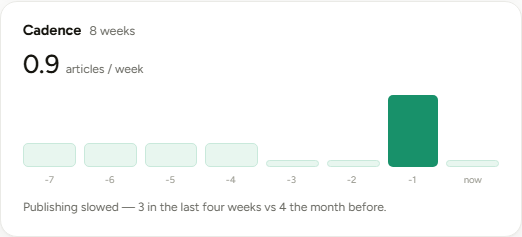
The Cadence card on your site Dashboard shows the last eight weeks as bars with your average underneath, and a line spelling out whether you are up, down, or steady against the previous four weeks.
This is the number to check monthly, and the only one worth reacting to. A cadence that reads 0.9 when you set 7 per week means something stopped: an empty queue, an exhausted allowance, or a pile of drafts waiting on approval.
Scheduled generation runs once a day at 08:00 UTC. If more is due than can run that morning, the leftovers stay queued and get picked up on following days rather than being dropped.
A worked example
A two-person landscaping company in Denver, on Growth. Two sites: the main business site and a smaller one for their hardscaping arm.
Fifty articles a month, pooled, is 11.6 per week across both sites. Their real review capacity is about four articles a week, because one of them reads everything on a Sunday evening.
So the plan writes itself: 3 per week on the main site, 2 per week on the hardscaping site, which is 5 a week and 21.5 a month. That leaves roughly 28 articles of monthly headroom, deliberately unspent.
The headroom is the point. It covers a burst when a cluster is worth finishing fast, and it covers regenerating a piece that came out wrong.
Month five result: 96 articles live across the two sites, a Cadence card reading 5.1 per week and steady for eleven straight weeks, and no month where the allowance ran out mid-schedule. Unremarkable, which is what a working cadence looks like.
How to ramp, in three moves
Weeks 1 and 2: schedule one cluster at 3 per week. Set the Scope to a single cluster rather than All unscheduled. You get a complete, internally linked set of articles on one subtopic, which is far more useful than six scattered pieces.
Week 3: read articles two and five closely, fix the voice, then move to daily. Not every article. Two of them, properly, out loud.
Week 6: check the Cadence card, and only then decide whether to go faster. If it reads what you set, raise it. If it reads lower, the problem is approvals or quota, and raising the frequency will not fix either.
Turn Auto-Publish on after the fifth article you did not edit. Not after one good one. A run of five where you opened the draft, read it, and closed it without changing anything is the actual signal that the review step has stopped doing work.
The line to remember
The best publishing schedule is not the fastest one you can afford.
It is the one still running in month nine, when the articles you queued in month two finally start moving and you had nearly stopped looking.
Auto Scheduling: the dialog, the calendar, and the toggles→ Plans and pricing: what your pooled allowance is→ Topical authority: why depth beats breadth→ The Authority Map: scheduling one cluster at a time→Was this page useful?
Tell us what was missing and we'll fix the page.