What a Keyword Really Is
What volume, difficulty, CPC and intent actually measure, why difficulty is a model rather than a fact, and when a zero-volume keyword is worth writing.
Updated Aug 26, 2026 · 9 min read
Every keyword tool shows the same four numbers next to a search phrase. This page explains what each one actually measures, which ones lie to you, and why a keyword with zero volume can still be the best thing you write this month.
The plain-language definition
A keyword is just a phrase somebody typed into a search box. That is all it is, and the word is a bit of a fossil at this point, since most of them are full questions now rather than keywords in any real sense.
What makes a keyword useful to you is not the phrase. It is the four pieces of data that come attached to it.
Run with a concrete example. Say you are an electrician who installs home EV chargers, and you write about it. Four real-shaped searches from your world, with illustrative numbers of the kind a keyword tool reports:
| Keyword | Volume | Difficulty | CPC | Intent |
|---|---|---|---|---|
| ev charger installation cost | 18,000 | 68 | $12.40 | Commercial |
| level 1 vs level 2 charging | 4,400 | 31 | $1.10 | Informational |
| tesla wall connector manual | 2,900 | 24 | $0.30 | Navigational |
| can I plug a level 2 charger into a dryer outlet | 0 | 4 | $0.00 | Informational |
Four rows, four completely different jobs. The first one funds the business and you will not rank for it this year. The last one shows a zero and might be the most valuable page on the list.
Here is why.
What each number actually measures
Volume is an estimate, not a count
Search volume is presented as "how many people search this per month", and it is really an average of the last twelve months, modeled from sampled data, then rounded into a bucket. Nobody outside Google has the true number, including Google's own Keyword Planner, which reports in wide ranges once you stop spending money with it.
Three consequences that catch people out.
- The average hides seasonality. A keyword at 18,000 per month might be 40,000 in January and 4,000 in July. If your niche has a season, the annual average is the one number that describes no month of the year.
- Volume is not clicks. A large share of searches end without anyone clicking a result, because the answer was already in a snippet, a map pack, or an AI overview. Volume tells you how often a question is asked, not how much traffic exists.
- Volume is per location and per language. The same phrase has a different number in the US, the UK, and Germany, and a tool pointed at the wrong market will quietly hand you a fantasy.
Treat volume as an order of magnitude, not a figure. The useful question is never "is this 4,400 or 3,900", it is "is this a hundreds keyword, a thousands keyword, or a tens-of-thousands keyword".
Difficulty is a model, not a fact
This is the one worth internalizing, because it is the number people trust most and should trust least.
There is no such thing as keyword difficulty. Google does not publish one, does not compute one, and has never described anything like it. Every difficulty score you have ever seen was invented by a tool vendor.
What those vendors actually do is look at the pages currently in the top ten and score how hard they look to displace, mostly from their link profiles. That is a reasonable proxy. It is also why two tools will happily show you 42 and 67 for the same keyword on the same day.
More importantly, difficulty is a property of the SERP, not of your site. A score of 60 is unwinnable for a three-month-old blog and routine for an established site in the same niche. The same number means two different things depending on who is reading it.
The common mistake: filtering the whole keyword list to difficulty under 30 and calling it a strategy. That filter removes every commercially valuable term in your niche and leaves you with a blog full of pages nobody was ever going to buy from. Difficulty is a scheduling input, not a selection criterion.
CPC is the honest one
Cost per click is what advertisers are willing to pay for one click on that search. It is the only number in the row grounded in somebody's actual money.
That makes it the best available proxy for commercial value. When "ev charger installation cost" carries a $12.40 bid, it is because advertisers measured that those clicks turn into $2,000 jobs often enough to justify it.
The reverse inference is where people slip. A $0.00 CPC does not mean the keyword is worthless; it means nobody is bidding, which is frequently true of exactly the practical questions your future customers ask before they know they are shopping.
Intent is not a number at all
Intent is what the searcher wants to happen next: learn something, go somewhere specific, compare options, or buy. It is usually shown as a label, and it is the only field in the row that decides whether your article can rank at all.
Get intent wrong and the other three numbers stop mattering entirely. A brilliant 3,000-word guide will not rank for a query where Google has already decided the answer is a product grid.
It is a big enough subject to have its own page, and it is the one I would read next.
Search Intent: The Four Types→Why zero-volume keywords are worth writing
Back to that last row: "can I plug a level 2 charger into a dryer outlet", volume 0.
Zero in a keyword tool almost never means zero. It means "below the threshold where our sampled data can see it", which is usually somewhere under ten searches a month. Long, specific, conversational questions live below that line by design, and there are millions of them.
Three reasons to write them anyway.
- The tail sums. Nobody searches that exact dryer-outlet phrasing 500 times a month, but the forty near-identical phrasings of the same worry do, and one good page catches all of them. Pages that rank for one long-tail query typically rank for dozens nobody targeted.
- Question keywords are what AI engines quote. An answer engine looking for a source needs a passage that answers a specific question directly. A page built around a real question, with the answer stated plainly, is far more quotable than a page built around a head term.
- The intent sits further down the funnel. Somebody asking whether their dryer outlet will work is planning an installation this month. Somebody searching "ev charger" is doing nothing in particular.
The counterweight, so this does not become its own cargo cult: a zero-volume keyword earns a page when it is a real question real people ask, verifiable from forums, Reddit, your support inbox, or the "People also ask" box. It does not earn one because a tool generated a grammatically valid phrase with no data behind it.
A quick test that works: paste the zero-volume phrase into Google. If real forum threads, community questions, and dedicated pages come back, people are asking it and the tool simply cannot see them. If you get loosely related results and nothing on point, the tool is right and the phrase is noise.
How this works in RankSpiral
The Keywords tab of the Authority Map is these numbers, laid out deliberately plainly. Seven columns: Keyword, Volume, Difficulty, CPC, Cluster, Scheduled, Status.
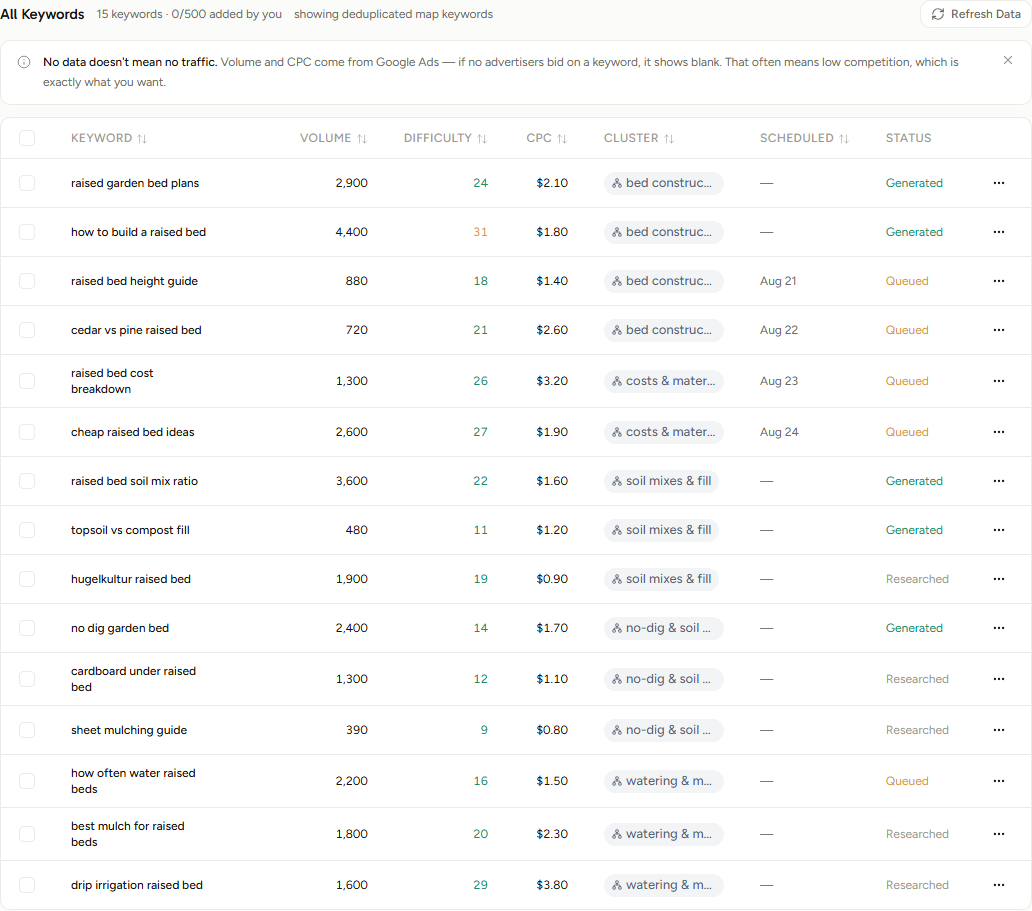
Three things in there are opinions rather than neutral display choices.
- Volume carries its own trend line. When a keyword has monthly history, a small 12-month sparkline sits beside the number, precisely because the average hides the season and one glance tells you whether you are looking at a flat line or a January spike.
- Difficulty is a bare number with no band label. It is colored (green under 30, amber from 30, red above 60) but never called Easy or Hard, because as covered above, the same score means different things for different sites.
- Blank is a state, not a failure. Volume and CPC come from Google Ads data, so a keyword nobody bids on shows blank. The tab says so in a note above the table: no data does not mean no traffic, and often means low competition.
Intent is the one field deliberately not in that table. It appears where it changes a decision instead: on the suggestions dialog, in the Gaps matrix, and in the Generate Article dialog, which reads intent to decide what kind of article to write.
For finding new keywords, Suggest Keywords sits at the top of the Keywords tab. It pulls candidates from live search data around your niche and your competitors, then has the model pick up to 20 of them, each shown with its volume, its difficulty, and an intent pill... plus a warning when a suggestion looks too similar to a keyword you already have. AI requests are metered per month and reset on the 1st.
One honest limit worth knowing: RankSpiral's keyword data comes from the same commercial source everyone else uses, so the estimates here are no more true than the estimates anywhere else. The difference is in what gets done with them, not in the numbers.
Going deeper
- "One keyword per article" is a half-truth. One intent per article is the real rule. A page targeting "ev charger installation cost" should absorb "how much does it cost to install a home charger" too, because that is the same question wearing different clothes.
- Difficulty scores age badly. They describe the top ten on the day they were measured. A SERP that got easier because two ranking pages went stale will not tell you until you look again.
- Volume without a path to conversion is a vanity metric. A 60,000-volume keyword that brings readers who will never hire an electrician costs exactly as much to write as one that brings ten buyers.
- Keyword density is dead and has been for over a decade. There is no target percentage, no ideal number of repetitions, and stuffing the phrase in is now actively counterproductive. Put it in the title, use it where it is natural, move on.
- Where the standard advice breaks: in tiny B2B niches the entire viable keyword set may show low or zero volume, and the numbers become close to useless. There you select by customer relevance and let sales conversations, not the tool, tell you what to write.
The four numbers are a briefing, not a verdict. They tell you what a search is worth and roughly what it will take; they cannot tell you whether you are the right site to answer it, and that judgment is still yours.
Keyword Clusters and Pillars, Explained→ Topical Authority: Why Depth Beats Breadth→ Topical Map→ Rank Tracking→Was this page useful?
Tell us what was missing and we'll fix the page.