
Stop Chasing AI Ranking Tricks
Somewhere right now, a marketer is adding "As an AI language model would say..." to their blog intro, hoping ChatGPT notices.
It won't.
And if you've been sold a secret GEO hack in 2026, you're probably holding a very expensive placebo.
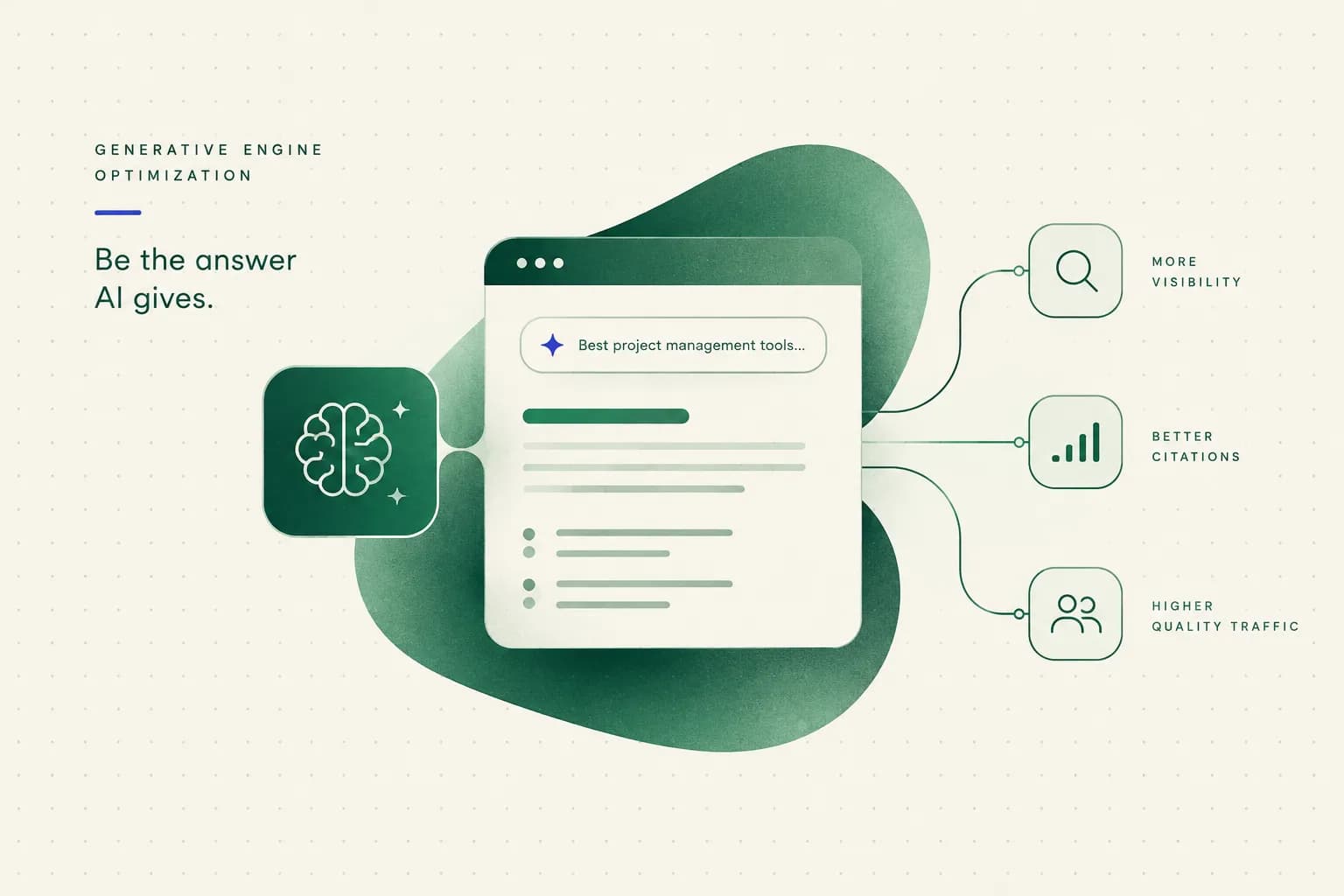
Generative engine optimization (GEO) is the practice of making your content and your brand entity legible to AI answer systems. That includes Google AI Overviews, AI Mode, ChatGPT, Perplexity, Claude, Gemini, and Copilot. "Legible" is the key word here: these systems need to find you, understand you, trust you, and then decide you're worth quoting.
Here's the part the hype merchants skip.
GEO is not a mysterious new discipline that replaces everything you know. It sits on top of existing SEO: crawlable pages, deep topical coverage, clear entities, and sources other people trust.
You'll also hear it called answer engine optimization, which is the same idea wearing a different badge.
So why does any of this matter if you already rank?
Because ranking is no longer the finish line.
AI-generated answers now sit above the organic results on a growing share of queries, which means even a page in position one can lose clicks to a summary that paraphrases it.
The data backs this up. A 2025 Pew Research Center study found that users clicked a traditional result link on just 8% of visits when an AI summary appeared, compared with 15% when it didn't. Ahrefs research from the same year estimated that AI Overviews cut click-through for the top-ranking page by roughly a third.

That's the stakes.
Not "will AI kill SEO" (it won't), but "will your good work get credited, or just quietly absorbed?"
Here's what this guide covers.
First, the generative pipeline and where most sites get filtered out. Then how citations are actually earned, a practical generative engine optimization strategy you can build step by step, the technical access issues that silently block you, and finally how to measure any of it without fooling yourself.
Still with me?
Good.
No tricks ahead, just the stuff that works.
What GEO Actually Means
Most brands don't lose AI visibility at the "answer" stage.
They lose it five steps earlier, before a model ever reads a word they wrote.
Understanding where the drop-offs happen is the fastest way to stop wasting effort.
The Generative Search Pipeline
Think of AI search as a nine-stage airport security line. Your content has to clear every checkpoint, and nobody cares how nice your outfit is if you didn't get through the first scanner.
Here's how it flows.
Query activation is when the engine decides whether a prompt deserves an AI answer and whether it needs live search to produce one. Then come crawling and indexing, where your pages are fetched and stored.
If you're blocked, broken, or noindexed, you're out.
Most sites that "can't get cited" are filtered right here.
Next is retrieval, where the system pulls a pool of candidate pages that might answer the query. This is classic retrieval-augmented generation: the large language model doesn't just remember things, it fetches documents to ground its answer.
Reranking then sorts those candidates by relevance and trust, and context selection picks the specific passages the model will actually read.
Finally, the model handles generation (writing the answer), citation (deciding which sources to attribute), and the last stage, user action, where a person clicks, buys, books, or closes the tab.
Each stage narrows the field.
By the time you reach citation, you're competing with a handful of sources, not thousands.

Now the unglamorous truth.
Google's own Search Central guidance on AI features says the same fundamentals apply: pages must be indexable and eligible to show a snippet. Crawlability, indexability, topical authority, and credible links still gate eligibility before any AI-specific factor enters the picture.
No foundation, no house.
From Retrieved to Recommended
Brands often celebrate "showing up in AI" without knowing which kind of showing up they mean. There are five distinct outcomes, and they're worth very different amounts.
- Index-eligible: Your page is crawled, indexed, and technically allowed to appear. Example: your guide to running shoes is in Google's index with no snippet restrictions. Necessary, but nobody's clapping yet.
- Retrieved: The engine pulled your page into its candidate pool for a query. Example: Perplexity fetched your shoe guide while answering "best shoes for flat feet" but didn't use it.
- Mentioned without a link: The answer names your brand but cites someone else. Example: ChatGPT lists your shoe brand in a roundup, sourced from a review site.
- Cited with a link: Your page appears as a clickable source. Example: an AI Overview quotes your sizing chart and links to it.
- Recommended toward an action: The engine actively points users to you. Example: Gemini answers "where should I buy wide-fit trail shoes?" with your store as the top suggestion.
Mentions build brand awareness.
Citations drive referral traffic.
Recommendations drive revenue.
Track them separately, or you'll be popping champagne over the wrong number.
Why Entities Need Clarity
AI systems don't think in keywords.
They think in entities: people, companies, products, and the relationships between them, often mapped in something like Google's knowledge graph.
Entity clarity means describing your brand the same way everywhere. Your website, Wikipedia (if you qualify), LinkedIn, Crunchbase, and industry directories should all agree on what you are, what you do, and who runs it.
It also means named authors with real, verifiable credentials, not "Admin" or "Marketing Team." And it means explicit product and service definitions: "Acme Payroll is cloud payroll software for US businesses with 10 to 500 employees" beats "We help teams thrive" every single time.
If a model can't tell what you are in one sentence, it won't risk recommending you in one either.
Your GEO Strategy Framework
A good generative engine optimization strategy looks suspiciously like good content strategy with better research.
That's not a coincidence.
Here's how to build it in three phases.
Map Prompts Across Intent
People don't type prompts the way they type keywords.
"CRM software" becomes "what's a CRM that won't make my sales team quit?"
Your research has to catch that shift in search intent.
Quick check-in: if your current content plan only covers informational queries, you've found your first gap. Post-purchase prompts in particular are wildly under-served and easy to win.
Build Clusters, Not Pages
One brilliant standalone article is like one brilliant tweet.
Nice, but nobody's calling you an authority.
Reranking systems weight topical depth, so content clusters consistently outperform orphaned posts.
Why does this work?
When the reranker sees ten tightly connected pages on one topic from one source, it reads that as topical authority.
One page is a guess.
Ten linked pages is a pattern.
Write for Extraction
Content extractability is how easily a model can lift a clean, accurate passage from your page. Write like someone will quote you out of context, because someone (well, something) will.
Technical Access and Real Citations
You can write the best page on the internet and still be invisible to AI search because of one line in a file you forgot existed.
Technical access is boring.
It's also where a shocking number of brands quietly lose.
The Technical Checklist
Start with crawler directives.
Check your robots.txt for GPTBot (OpenAI's training crawler), OAI-SearchBot (ChatGPT search), PerplexityBot, ClaudeBot, and Google-Extended. One nuance: blocking Google-Extended limits Gemini training use, but it doesn't remove you from AI Overviews, which rely on standard Googlebot.
Next, test JavaScript rendering.
Many AI crawlers don't execute JavaScript well, so if your content only appears after client-side rendering, they may see a blank page. Server-side rendering or a pre-rendered fallback fixes this.
Then cover the basics that still trip up big sites.
Keep your XML sitemaps fresh with accurate lastmod dates. Make sure canonical tags are consistent so engines aren't splitting signals across duplicates.
And run a noindex audit, because a stray tag left over from a staging environment can hide your best page for months.
Earning Citations Honestly
Generative engines lean heavily on third-party corroboration.
If only you say you're great, that's marketing.
If journalists, experts, and customers say it, that's evidence.
Legitimate signals include original research others cite, quoted experts with real credentials, genuine reviews on established platforms, and journalist coverage earned through digital PR. These create brand mentions across independent sources, which is exactly what source attribution systems look for.
Then there's the other stuff.
Fake profile networks, seeded Reddit threads, paid placements disguised as editorial, and AI-generated "review" sites.
Generative engines are built to discount these patterns, and the downside isn't just wasted money.
It's your brand getting associated with spam in the very systems you're trying to impress.

Fix Old Content First
Here's a counterintuitive move: before you publish anything new, audit what you already have.
Your back catalogue is probably sitting on more citation potential than your next ten posts combined.
Look for three things.
First, pages ranked 11 to 30, which are close enough to break through with a refresh. Second, pages getting impressions but no AI citations, meaning engines see them but don't trust them enough to quote. Third, posts with stale facts or dead links, which actively undermine credibility.
Doing this manually across hundreds of posts is... a lot.
That's where approval-gated automation helps.
Rankspiral's Retrolink is a working example: it checks dozens of posts weekly, flags ranking slips, and proposes retrofitted internal links or data updates.
The key detail is that every change waits for human approval, so nothing gets silently edited on a live page.
That approval step matters more than it sounds.
Scaling AI content without fact-checking or editorial review is a real risk, because inaccurate brand claims can get picked up, repeated, and cited as fact by multiple AI systems.
One wrong pricing figure on your blog can become "common knowledge" across three chatbots within weeks.
Takeaway: in GEO, an error doesn't just sit on your page. It gets syndicated by machines that trust you.
Measuring What's Actually Working
Checking ChatGPT once, seeing your brand, and declaring victory is the GEO equivalent of weighing yourself after a haircut.
Technically data.
Not useful data.
The fix is prompt monitoring with a fixed panel.
Take 20 to 50 real customer prompts (the master list from your research phase), run them across ChatGPT, Perplexity, Gemini, Copilot, and Google AI Mode every month, and log your citation rate and citation position over time.
Same prompts, same cadence, so the trend line actually means something.
Rankings still matter, but they're now one input among several. Here's what to track and why:
| Metric | What It Reveals | How to Track It |
|---|---|---|
| Citation rate | The percentage of your prompt panel where your site appears as a linked source | Monthly manual prompt runs logged in a spreadsheet, or AI visibility tools like Profound or Peec AI |
| Citation position | Whether you're the first source cited or buried as source number seven | Record the order of citations per prompt; compare month over month |
| Source overlap with competitors | Which third-party sites engines trust for your topic, and where competitors get cited instead of you | Ahrefs Brand Radar or Semrush AI Toolkit cited-domain reports |
| Mention sentiment | Whether AI answers describe your brand positively, neutrally, or with caveats | Sentiment analysis features in Otterly.ai, Scrunch, or manual tagging |
| Share of voice | Your brand's portion of total mentions across your prompt panel versus competitors | Brand mention counts per prompt divided by total brand mentions |
| Referral traffic | Actual visits arriving from chatgpt.com, perplexity.ai, gemini.google.com, and copilot.microsoft.com | GA4 referral reports with a custom channel group for AI sources |
| Assisted conversions | Whether AI-referred visitors contribute to sales later, even if they don't convert on first visit | GA4 conversion paths or your CRM's attribution reports |
Notice that only the last two connect to revenue.
Citation visibility is a leading indicator.
Referral traffic and assisted conversions tell you whether it's paying the bills.
Why Results Vary by Model
Run the same prompt twice and you might get two different answers.
That's not a bug.
It's how these systems work.
Visibility shifts by model (Claude and Perplexity favor different sources), location, language, and even small changes in query wording. It also depends on freshness and whether the engine uses live retrieval or leans on cached training data.
A brand absent from a model's training set might still win citations through live search, and vice versa.
That's why a single snapshot is misleading.
Monthly panels, averaged over time, smooth out the noise and show you the real direction.
Frequently Asked Questions
What is an example of generative engine optimization?
A classic example is rewriting a buried FAQ answer so it directly answers the question in its first sentence, adding original data, and linking it into a topic cluster. A payroll company might restructure its "how long does payroll setup take" page this way and start appearing as a cited source in Google AI Overviews for that query.
Is GEO replacing SEO?
No, GEO extends SEO rather than replacing it.
AI answer engines still depend on crawlable, indexable pages with topical authority and credible links. Strong SEO is the entry ticket; GEO is about what happens after you're through the door.
How do you optimize content for AI search?
Optimize for AI search by answering questions directly in the first two sentences, phrasing headers the way people ask prompts, and including original data or expert quotes. Build content clusters with consistent internal linking, keep facts current, and make sure AI crawlers can access and render your pages.
How do I get my website cited by ChatGPT?
Your website gets cited by ChatGPT when its search crawler can access your pages and your content is trusted enough to rank well in the results ChatGPT retrieves. Allow OAI-SearchBot in robots.txt, publish extractable answers, and earn third-party brand mentions through digital PR and genuine reviews.
There's no form to submit, unfortunately.
What are the ranking factors for generative engine optimization?
The confirmed foundations are indexability, crawlability, topical authority, entity clarity, and credible third-party corroboration. Practitioners consistently observe that original data, clear definitions, and direct answers help.
Tactics like specific word counts, bullet density, or magic phrases remain unproven, so treat anyone selling them as certainties with healthy suspicion.
What tools can track brand visibility in AI search results?
Tools that track brand visibility in AI search include Profound, Peec AI, Otterly.ai, Scrunch, Ahrefs Brand Radar, and Semrush's AI Toolkit. Most monitor citations, brand mentions, sentiment, and share of voice across ChatGPT, Perplexity, Gemini, and Google AI Overviews.
Pair them with GA4 to connect visibility to referral traffic.
Audit Before You Publish
Look at the brands dominating AI citations in 2026 and you'll notice something awkward.
They had strong SEO, clear entities, and disciplined content operations long before anyone said the word "GEO."
They didn't find a trick.
They just did the boring things consistently.
So here's your one action for this week.
Pull the list of pages ranked 11 to 30 in Search Console. Check which ones already get impressions but zero AI citations.
Fix those (sharper answers, updated facts, better internal links) before you write a single new post.
GEO rewards operational consistency, not clever formatting.
The machines have read everything.
They can tell who did the homework.