
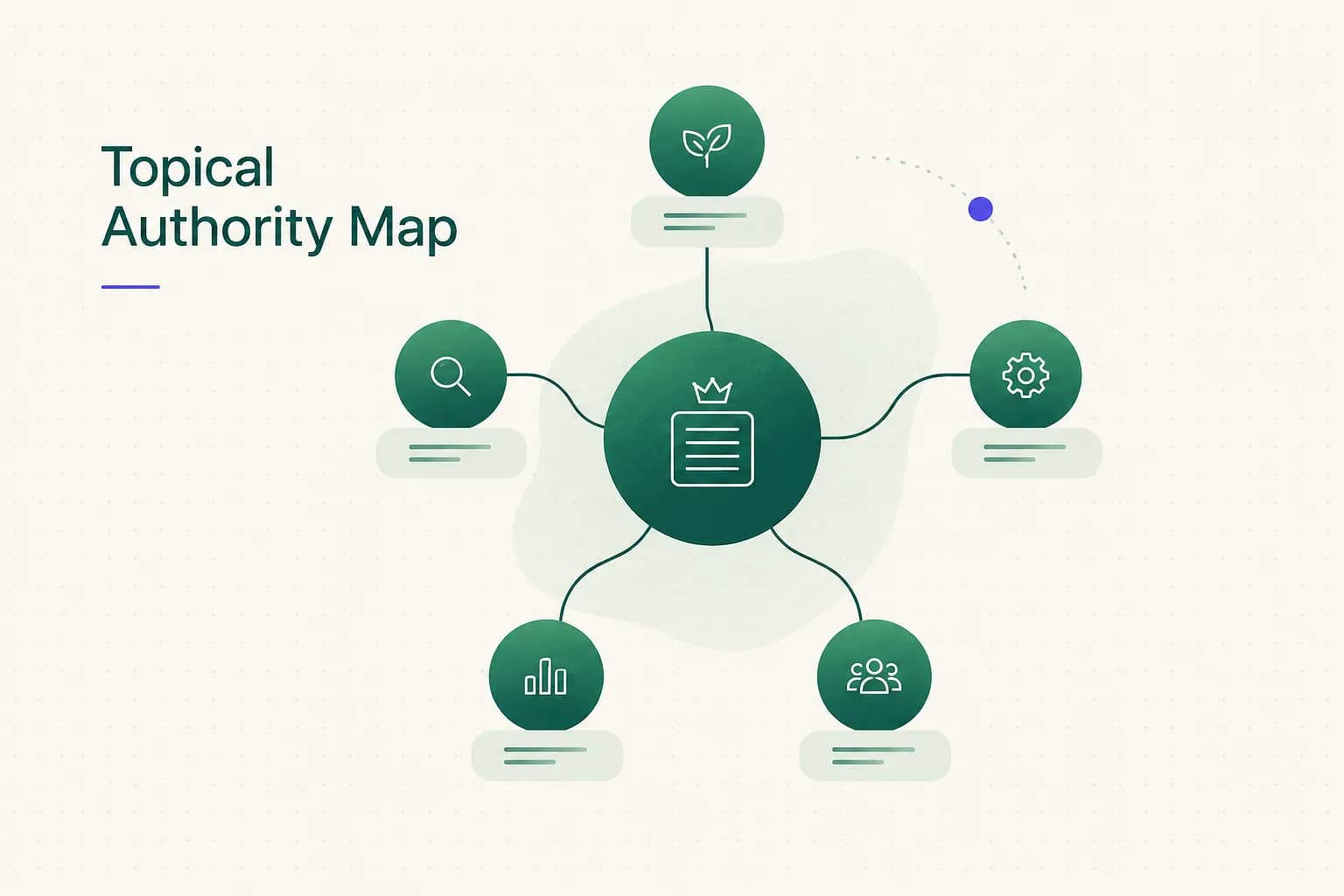
What a Topical Authority Map Really Is
Here's something most SEO tools won't say out loud: there is no "topical authority" number sitting inside Google.
No dial, no score, no secret leaderboard where your site sits at 73 out of 100.
And yet entire content strategies are built around chasing it.
A topical authority map is a structured plan that connects your pillar topics, subtopics, entities, and search intent across your whole site. It isn't a single pretty diagram you make in a whiteboard app and forget about.
It's the blueprint that tells you which pages should exist, what job each one does, and how they link together.
Think of it like a city plan rather than a sketch of one building.
A sketch tells you what one house looks like. A city plan tells you where the roads go, which neighborhoods connect, and why nobody should build three post offices on the same block.
Now for the honest part.
"Topical authority" is an industry term coined by SEO practitioners, not an official Google ranking signal or a documented metric in Google's public guidelines. Google has described a "topic authority" system for surfacing expert news publishers, but there's no published sitewide topical authority score you can check or game.
Why does that distinction matter?
Because sites that think authority is a number start chasing volume. They publish 200 posts to "hit the threshold" that doesn't exist, while ignoring the things that genuinely move rankings: complete coverage of what searchers need, and internal linking that makes the relationships between pages obvious to both users and crawlers.
Topical authority isn't something you earn by publishing more. It's what Google appears to reward when your site answers a subject more completely and more clearly than the alternatives.
So this guide takes a different angle. Your topical map is a decision system: a way to decide what to publish, what to combine, and what to skip entirely.
Volume doesn't equal authority.
Coverage, structure, and clarity get you a lot closer.
Topical Maps vs Topic Clusters
Quick check-in: if you've ever exported 500 keywords, run them through a clustering tool, and called the result a strategy... you're in good company.
Most people do this.
It's also where most topical maps quietly go wrong.
A topic cluster is usually just a keyword list grouped by similarity. "Coffee roasting temperature" goes with "coffee roasting temp chart" because the words look alike.
That's useful, but it's only the first layer.
A topical map adds four more: the entities involved, the search intent behind each query, SERP validation that proves which queries belong together, and business priority so you know what's worth building first.
A cluster is a pile of bricks.
A map is the floor plan.
The problem with keyword similarity alone is that wording lies.
Take "espresso roast" and "espresso roast level." They share two words and look like siblings.
But "espresso roast" often pulls up product pages and bean shops, while "espresso roast level" pulls up explainers about how dark espresso beans should be roasted.
Same words.
Completely different page types.
Put them on one page and you'll satisfy neither searcher.
That's why the real test is SERP overlap.
If two keywords share several of the same ranking URLs in Google's top 10, Google is telling you one page can satisfy both. A common rule of thumb among practitioners is three or more shared URLs before you merge.
If the results barely overlap, they need separate pages, no matter how semantically close the keywords seem.

Then there's the layer most keyword-only guides skip entirely: entity SEO. Entities are the concrete things and ideas your topic is made of, and they fall into useful buckets:
Attributes (roast level, bean density, moisture content), processes (first crack, development time, degassing), tools (popcorn popper, drum roaster, thermocouple), problems (scorching, tipping, uneven roasts), and outcomes (sweetness, acidity, body). Mapping these entity-attribute relationships shows you what a genuinely complete treatment of a topic looks like, including subtopics nobody is searching for in volume yet.
Building the Map Step by Step
Time to build the thing.
The process below works whether you're starting a brand-new content hub or reorganizing a site that's been publishing for years. Grab a coffee (thematically appropriate) and follow along.
Start With Entities, Not Keywords
Keyword tools only show you what enough people already type into Google. The richest subtopics often hide in places with zero reported search volume.
Mine these sources first:
Validate Clusters With Live SERPs
This is the step that separates a real topical map from a guess.
Before merging or splitting anything, check what Google already rewards.
Page, Section, or FAQ?
Once your SERP data is in, every keyword gets sorted using one simple decision rule.
Print this out.
Tape it to your monitor.
It will save you from the "should this be its own post?" debate forever.
From Keyword List to Map
Let's make this concrete.
Here's how a raw 40-keyword export for "home coffee roasting" becomes a working map.

Forty keywords.
Nine pages plus an FAQ block.
Not forty thin posts fighting each other.
That's the whole point.
Linking Pillars to Profit
A topical map without internal links is like a library where every book is shelved randomly.
The information exists.
Nobody can find it, including Google.
The Internal Link Direction That Works
Internal links aren't just "add a few related posts at the bottom." Direction matters, and a clean pattern makes your information architecture obvious at a glance.
The pillar links down to every supporting page in the cluster.
Each supporting page links up to the pillar, and sideways to adjacent clusters where it genuinely helps the reader.
Then two or three pages per cluster, usually the comparison and buyer-intent pieces, link to a money page like a product, category, or service page.

This structure does something sneaky and wonderful: it prevents keyword cannibalization. When each page has one clear job, Google doesn't have to choose between five of your pages that all half-answer "how to roast coffee at home."
The pillar owns the broad query.
The popcorn popper guide owns its specific query.
Nobody steps on anybody's toes.
Contrast that with the typical unplanned blog.
Five posts mention roast levels, three cover popcorn poppers, and Google Search Console shows them swapping places week to week for the same query. That rank-flicker is cannibalization in action, and it usually means none of them ever reaches page one.
What to Publish First
So you've got a map with 40 planned pages.
Which one first?
Not the one you're most excited to write, sadly.
Use these prioritization factors instead:
Current ranking position 11 to 30. This is quick win territory.
You already have some relevance, and a stronger page or better internal links can push you onto page one, where the overwhelming majority of clicks happen.
Estimated conversion potential. A comparison page between two roasters is closer to a purchase than a history of coffee roasting.
Weight your queue toward pages that sit near buying decisions.
Topical gaps competitors haven't covered. Run a quick content gap analysis.
If none of the top 5 sites explain how bean density affects roast time, that's your opening to be the most complete answer.
Production effort for credible content. Some pages need original photos, testing, or expert input.
A page you can make genuinely great in four hours often beats one that needs four weeks.
And here's where most strategies stop too early: they measure success in traffic.
Traffic is nice.
Revenue is nicer.
Track assisted conversions, clicks from articles to money pages, and revenue per cluster, so you know which parts of the map are actually paying rent.
This is where tooling helps.
Rankspiral's winnability scoring estimates which clusters you can realistically rank for, and its click tracking attributes each click to a specific article and a specific link. So instead of "the coffee blog got 12,000 visits," you get "the air roaster comparison sent 340 clicks to the roaster category page."
One of those sentences gets budget approved.
Fixing an Old Content Library
If your site already has 150 posts, the most valuable move usually isn't writing post 151. It's figuring out what the first 150 are doing.
(Spoiler: some of them are doing nothing. A few are actively fighting each other.)
Audit, Merge, Redirect, Refresh
Start by grouping every existing post against your new map. Each URL either fits into a cluster, overlaps with another URL, or doesn't belong anywhere.
Then decide per page, one of four actions.
Keep pages that already rank, match their cluster's intent, and just need links wired into the new structure. Merge pages that target the same SERP; this content consolidation folds the best parts of two or three weak posts into one strong one.
Redirect the merged or obsolete URLs with 301s so their existing links and signals flow to the surviving page. Rewrite pages that target the right topic but miss the intent, like a 400-word opinion post sitting on a SERP full of detailed how-to guides.
Notice what's missing from that list?
"Write something new."
That should be the last resort for each gap, not the default. Content pruning feels scary, but sites regularly report that consolidating overlapping posts lifts rankings for the surviving page.
Now a warning, because it's 2026 and this mistake is everywhere.
Stacking more AI-generated pages onto an unaudited library doesn't create authority.
It creates thin content, topic drift, and cannibalization, regardless of how many pages you publish per week.
Publishing 50 AI articles onto a messy site is like adding more rooms to a house with a cracked foundation. The square footage goes up. So do the problems.
When Is a Cluster Done?
Great question, and almost nobody answers it.
Without completion criteria, clusters either get abandoned halfway or expanded forever.
Here's a practical checklist.
Intent coverage: the cluster answers definitional ("what is first crack"), how-to ("how to roast in a popcorn popper"), comparison ("air vs drum roaster"), and troubleshooting ("why are my beans scorched") needs. Entity coverage: the key attributes, processes, tools, problems, and outcomes from your entity list all appear somewhere sensible.
Internal links fully connected: no orphaned pages, every supporter links to the pillar, and the pillar links to every supporter. Ranking breadth: the cluster shows organic impressions across most of its target terms in Google Search Console, not just one or two head terms.
Finally, the gut check: is there an obvious user task you still can't help with?
If a reader would have to leave your site to solve a common problem in this topic, the cluster isn't done.
If not, stop writing and move to the next cluster.
Maintenance Nobody Talks About
Here's the unglamorous truth: a topical map starts decaying the day you publish it.
Competitors publish, products change, and searchers start asking new questions.
Content decay is quiet, which is exactly why it's dangerous.
Build a weekly maintenance loop around four checks. Look for ranking decay (pages slipping two or more positions over a month), new SERP entrants (a competitor's fresh page suddenly in your top 5), changing product lines (discontinued items still linked from old posts), and emerging questions (new PAA entries or rising Search Console queries with low click-through rate).
Doing this manually across hundreds of posts is... a lot.
Rankspiral's Retrolink is one example of automating it: it checks existing posts weekly, retrofits internal links into old content as new pages go live, and flags dead product links with one-click swaps.
That last one matters more than it sounds, because a broken link to a discontinued product is a lost sale wearing a disguise.
Topical Authority Map FAQs
What is the difference between topical authority and domain authority?
Domain authority is a third-party metric about your whole site's backlink profile, while topical authority describes how deeply and completely you cover one subject.
Domain authority comes from tools like Moz and isn't used by Google. Topical authority has no official score either; you measure it informally through rankings across a topic, ranking breadth, and engagement.
How long does it take to build topical authority?
It depends on competition and consistency, not a fixed number of months.
In a thin niche with weak competing pages, you can see ranking movement within a few weeks of publishing a well-linked cluster. In competitive niches like finance or software, expect two or more quarters of steady, complete coverage before rankings broaden meaningfully.
What is an example of a topical map in SEO?
A simple example is a pillar page on "business coffee roasting at home" linked to supporting pages that each target a distinct SERP.
Those supporters might include a grind-size guide, an equipment buying guide, a troubleshooting page for uneven roasts, and a comparison of air vs drum roasters. The pillar links to all four, each links back, and the equipment and comparison pages link to relevant product pages.
How many blog posts do you need to build topical authority?
There's no magic number, and the "X posts equals authority" idea is a myth.
What matters is coverage completeness and internal linking. Fifteen well-linked pages that answer every major intent in a topic can easily outperform 60 thin posts that overlap and cannibalize each other.
Does internal linking improve topical authority?
Yes, internal linking passes relevance signals and crawl paths between related pages.
It helps Google understand how your content connects and which page is the main resource for a topic. It's also one of the few mechanics behind topical authority you can act on today, often in an afternoon.
Is topical authority still important for SEO in 2026?
Yes, topical authority is still important in 2026, arguably more than before.
AI-driven search features and answer engines rely on clear entity relationships and well-supported content when choosing sources to cite. Isolated pages targeting single keywords give them little context, while a connected, complete content hub gives them plenty.
The Map Is Never Finished
If you take one thing from this guide, make it this: a topical authority map isn't a document you create, admire, and file away after launch.
It's an operating process.
The best maps get edited every month because the SERPs they're built on change every month.
That might sound exhausting.
It's actually freeing.
You stop asking "what should we write next?" in a vacuum and start answering it with evidence: shared rankings, intent gaps, and clicks to money pages.
Your next action is simple and doesn't involve writing anything new.
Audit your 10 most-read existing pages against intent and entity coverage.
Check whether each one has a clear job, links to its pillar, and covers the entities a searcher would expect.
Then use this decision summary for everything that follows:
If the SERP already rewards depth, build the cluster. If your rankings are stagnant because of thin, overlapping pages, consolidate before adding more.
Build less, connect more, and measure what actually pays.
Your future self (and your Search Console reports) will thank you.