
Find Competitor Keywords Without Copying the Competition
Everyone's Copying the Same Ten Keywords
Most guides on how to find competitor keywords read like a heist manual.
Sneak into their analytics. Steal their list. Publish before they notice.
That framing is fun, and it's also completely wrong.
Competitor keyword research isn't espionage.
It's pattern recognition.
You're not stealing anything, because keyword data was never hidden in the first place. Every ranking page a competitor owns is sitting in public search results, visible to anyone patient enough to look.
The skill isn't access. It's deciding which of those thousands of terms actually deserve a slot on your content calendar.
And that's where most teams fall apart.
They run a keyword gap analysis, export 2,400 rows, feel briefly powerful, and then... nothing.
The spreadsheet gets a nice filename and a permanent home in a shared drive nobody opens.
A keyword list is not a strategy. It's raw material. Strategy is what happens after you throw away 90% of it.
So here's the arc of this guide, and it's deliberately different from the "10 tools to spy on competitors" pieces you've already skimmed.
First, we figure out who your real organic search competitors are, which is almost never the list your sales team would give you. Then we pull keyword data using free methods before touching a paid tool.
After that, the unglamorous part: filtering. Cutting branded junk, unwinnable terms, and accidental rankings until what's left is actually actionable.
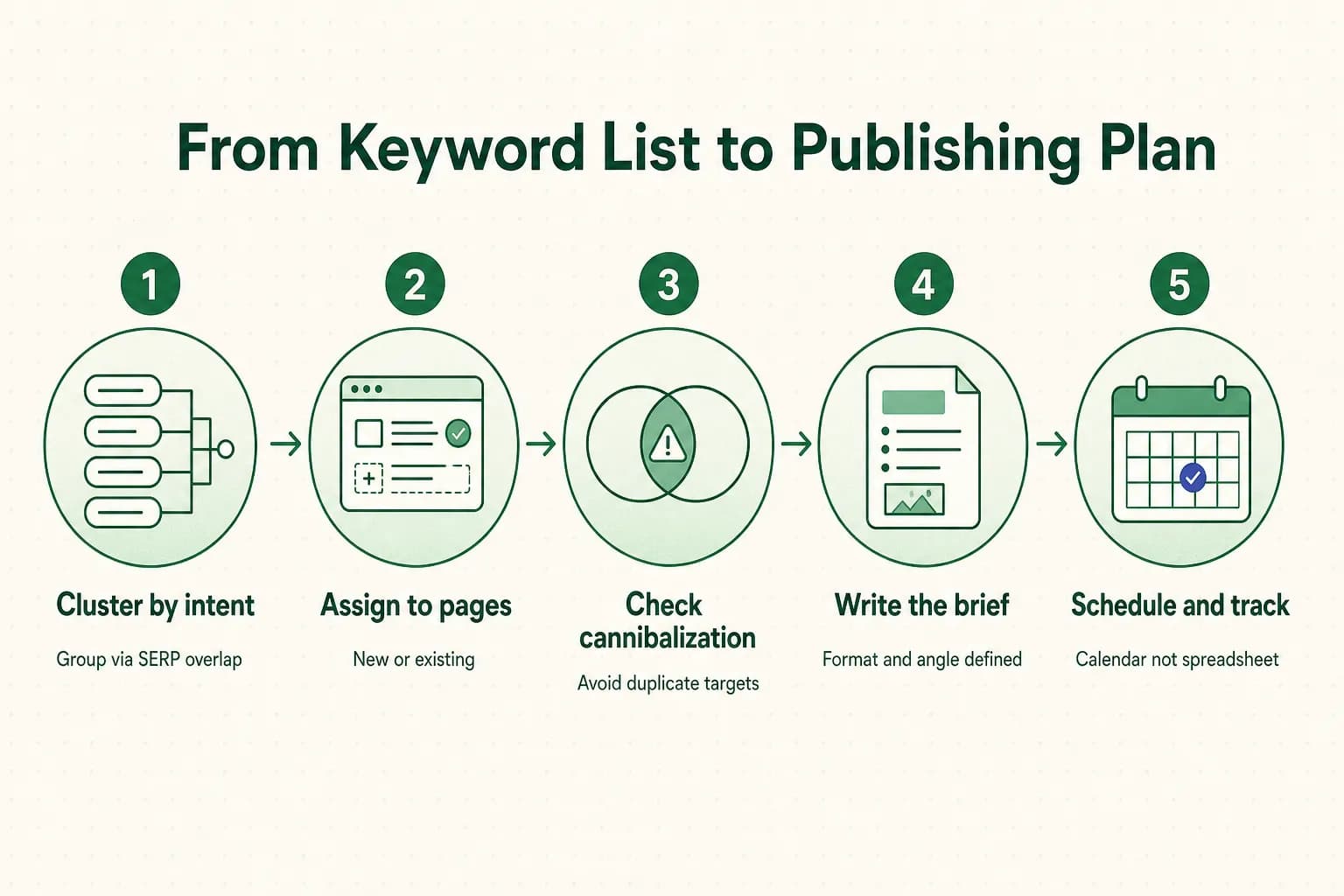
Finally, we turn the survivors into a publishing plan with clusters, page assignments, and a tracker you'll genuinely maintain.
Not a spreadsheet. A calendar.
Ready? Let's start with the uncomfortable question nobody asks first.
Business Rivals Aren't Always Search Rivals
Ask a marketing team to name their competitors and you'll get a confident list of three or four brands.
Ask Google the same question and you'll get a completely different answer.
Competitor keywords are simply the search terms a domain ranks for organically.
That's it. No intent, no strategy implied, just a domain and the queries it appears for in search results.
Which means a "competitor" in SEO terms is any domain occupying the real estate you want.
It doesn't need to sell what you sell. It doesn't need a sales team, a product, or even a business model.
The Domain That Keeps Outranking You
Here's a test you can run in about 25 minutes, and it's more useful than any tool's "similar sites" tab.
Take 15 to 20 keywords you genuinely want to rank for. Search each one in an incognito window.
Log the top 10 domains for every query in a simple spreadsheet.
Now count.
Which domains show up across most of those searches? Those are your real search competitor identification results, and the list will surprise you almost every time.
A domain appearing for 14 of your 20 target terms is competing with you far more directly than the rival brand your CEO mentions in every meeting. Google has already decided that domain is relevant to your topic space.
You're arguing with the referee if you disagree.
Quick check-in: have you ever actually done this, or have you been assuming your competitor set for the last two years?
Be honest.
Most teams inherit a competitor list from a pitch deck and never revisit it.
Why a Random Blog Might Be Your Real Competitor
Say you sell mattresses.
Your business rivals are other mattress brands, obviously.
Your search rivals? A sleep-health blog run by two physicians. A comparison directory with 400 review pages. A subreddit thread that somehow ranks for "best mattress for side sleepers."
And yes, one actual mattress brand, sitting at position seven.
This happens because Google rewards topical authority, not commercial legitimacy. A publisher who has written 180 articles about sleep has demonstrated depth across the entire topic.
Your product pages, however beautiful, cover maybe six angles.
Marketplaces, forums, and niche publishers consistently outrank direct business rivals for informational queries because they've spent years building that depth. They also tend to have link profiles that took a decade to accumulate.
The practical upshot: when you run competitor content analysis, analyze the domains that actually rank, not the ones that annoy your sales team. A mattress brand studying only other mattress brands will miss the entire informational layer of the funnel where buyers actually start.
Your real competitor set usually includes one or two direct rivals, one publisher, one aggregator or directory, and occasionally a platform like Reddit or YouTube.
Plan accordingly.
How to Actually Pull the Keyword List
You can do a genuinely useful version of this with zero budget. It takes longer, but the constraint forces better judgment, and judgment is the part tools can't sell you.
Free Ways to See What They Rank For
What Google Search Console Can and Can't Tell You
Let's clear this up because it causes endless confusion: Google Search Console never shows you competitor data.
Not one row of it. Ever.
What GSC gives you is something arguably more valuable: precise, first-party truth about your own performance. And that's the layer most people skip.
Layering Google Search Console performance data over third-party gap reports is the move that separates competent SEOs from spreadsheet collectors.
Third-party tools estimate. GSC knows.
When a Paid Tool Earns Its Keep
At some point the manual approach breaks.
Usually around competitor number four, when you realize you've spent six hours and produced a list you could have exported in ninety seconds.
Tool-agnostic takeaway: the export is the easy part.
What you do in the next section is the actual job.
Cutting the Noise Before You Trust the List
You now have a list.
It's probably huge, and probably 80% garbage.
That's normal.
Raw keyword gap analysis output includes every accidental ranking a competitor ever stumbled into, plus their brand name in nineteen variations. Filtering isn't optional cleanup.
It's the work.
The Junk Filter
Run these four cuts before you evaluate anything for quality. Most lists shrink by half in under ten minutes.
- Branded terms. Anything containing a competitor's company name, product names, or founder's name. You will not rank for "Casper mattress reviews" and you shouldn't want to.
- Navigational queries. "Login," "pricing page," "customer service number," "app download." These have intent you cannot satisfy.
- Accidental long-tail rankings. A term with 20 monthly searches where a competitor ranks position 6 from a single offhand paragraph. It's noise wearing a data costume.
- Off-audience topics. Big publishers rank for thousands of terms unrelated to their core business. If a marketing blog ranks for "how to fix a printer," that's not your opportunity.
- Geographic mismatches. Terms tied to markets you don't serve inflate your list and your expectations equally.
The Five-Factor Priority Score
What survives the junk filter gets scored. Five factors, 1 to 5 each, 25 points maximum.
Anything scoring 18+ goes into the next quarter's calendar.
| Factor | What You're Asking | Score 1 (Poor) | Score 3 (Moderate) | Score 5 (Strong) |
|---|---|---|---|---|
| Intent Match | Does the ranking SERP format match content you can credibly make? | SERP is all product listings; you have no product | Mixed informational and commercial results | Pure informational or comparison content dominates |
| Business Relevance | Does this query connect to something you sell or support? | Tangential topic, no path to conversion | Top-of-funnel, relevant audience, indirect path | Direct product or solution match |
| Ranking Feasibility | Can your current authority realistically compete? | KD 70+, top 10 all DR 80+ domains | KD 30-50, mixed authority in top 10 | KD under 25, or you already sit at position 11-30 |
| Traffic Potential | How much qualified traffic exists after SERP features take their cut? | Under 100/mo, AI Overview answers it fully | 300-1000/mo with some feature competition | 1000+/mo with clean blue-link SERP |
| Content Effort | What will it cost to produce something genuinely better? | Original research or tooling required | 2000+ words plus expert review | Existing asset can be expanded or refreshed |
Two things this table quietly protects you from, and both are expensive mistakes.
First: a competitor ranking page one doesn't mean the keyword is winnable for you. If their domain has 12 years of history and 40,000 referring domains, their position three is not evidence of low difficulty.
It's evidence of their topical authority, which you can't borrow.
Meanwhile, a term where you already sit at position 14 is often a two-hour refresh away from page one.
Boring? Yes. Profitable? Also yes.
Second: paid search keywords are not automatically organic targets. Seeing a competitor bid on a term tells you it converts, which is genuinely useful intelligence.
It does not tell you the organic SERP is winnable.
Plenty of high-commercial-intent terms have SERPs stuffed with shopping results, ads, and three DR 90 review sites. The competitor bids precisely because organic ranking there is hopeless.
Read that signal correctly.
Turning Gaps Into a Publishing Plan
Here's where 95% of competitor keyword projects die.
The list is filtered, scored, beautiful... and then someone asks "so what do we write first?" and the room goes quiet.
Group Keywords Into Clusters, Not Lists
One keyword per article is a strategy from 2013. It produces thin pages that compete with each other and confuse Google about which one to rank.
Keyword clustering works differently: group terms by shared search intent, not by string similarity.
The practical test is simple. Search two keywords and compare the top 10 results. If five or more URLs overlap, Google considers them the same intent, so they belong on one page.
Do this across your filtered list and structure emerges on its own.
A broad, high-volume term with many overlapping sub-queries becomes your pillar page. The distinct intents that didn't overlap become supporting articles that link up to it.
A cluster of one pillar plus six to eight supporting pieces builds topical authority far faster than fourteen unconnected posts. Internal links between them do real work here, not decorative work.

Match Each Keyword to the Right Page
Before you commission a single new article, check whether you already have a page targeting that intent. This takes thirty seconds and prevents months of self-inflicted damage.
Search site:yourdomain.com plus the keyword.
If an existing page shows up and genuinely covers the same intent, your action is consolidate or expand, not create. Two pages chasing one intent is keyword cannibalization, and it usually means neither ranks.
Then consider what the SERP actually looks like, because that decides whether the gap is worth pursuing at all. If an AI-generated answer resolves the query completely at the top of the page, click-through drops hard even from position one.
Similarly: a SERP dominated by Reddit threads means Google wants community opinion, not a brand article. A SERP full of video carousels means your blog post will fight for scraps.
SERP analysis isn't a formality, it's the qualifier.
If the SERP format doesn't match what you can produce, the keyword isn't an opportunity. It's a trap with good volume numbers.
Keep a Living Competitor Keyword Tracker
Build one sheet and keep it alive. These are the fields that actually get used, in the order you'll use them:
- Competitor URL and ranking page so you can re-check the source without hunting
- Keyword and search intent (informational, commercial, transactional, navigational)
- SERP format (listicle, guide, comparison, video, tool, forum)
- Your current position pulled from GSC, blank if unranked
- Content type to produce and relevance rating
- Priority score from the five-factor table
- Recommended action: create new, expand existing, consolidate, or ignore
That last column is the one that turns research into work. "Ignore" is a legitimate and underused entry.
On scope: analyze 3 to 5 real search competitors, refresh quarterly, and re-run immediately after a major algorithm update or when a new player starts appearing in your SERPs.
Monthly analysis is procrastination dressed as diligence.
Once this process feels repeatable but painfully slow, that's the signal to automate the mechanical parts. Platforms like Rankspiral read live SERP data to cluster keywords into pillar and cluster maps and generate content briefs automatically, which compresses the clustering-and-briefing stage from a week into an afternoon.
The judgment calls stay yours. The tedium doesn't.
Common Questions About Competitor Keywords
How do I find out what keywords my competitors are using?
Start by identifying your real organic search competitors: search 15-20 target keywords and log which domains appear repeatedly. Then run those domains through Google Keyword Planner's "Start with a website" option, which returns associated keywords for free.
Supplement with manual SERP scanning of their top pages and their blog category structure. Paid tools speed this up, but the identification step matters more than the export.
What tool can I use to see my competitors' keywords?
Google Keyword Planner is the best free option because you can paste a competitor URL instead of seed keywords and get their associated term list with volume ranges. It's free with any Google Ads account, no spend required.
Paid platforms like Ahrefs and Semrush offer larger databases and dedicated keyword gap reports with difficulty scores. Treat their traffic estimates as directional rather than precise, since third-party volume data is modeled, not measured.
How do I find keywords that competitors rank for but I don't?
Export your own ranking queries from Google Search Console, export competitor keywords from a gap tool or Keyword Planner, and subtract the overlap. What remains is your raw content gap.
Then filter aggressively: strip branded terms, navigational queries, and off-audience topics before evaluating anything. Pay special attention to terms where you already rank position 11-30, because those are the fastest wins in the entire list.
How do I do a competitor keyword analysis?
Four phases, in order: identify 3-5 genuine search competitors, pull their ranking keywords, filter out the junk, then score survivors on intent match, business relevance, ranking feasibility, traffic potential, and content effort.
Finish by clustering the winners into pillar and supporting pages, and assigning each one an action: create, expand, consolidate, or ignore.
If you stop before the clustering step, you have a spreadsheet rather than an analysis.
Can Google Keyword Planner show competitor keywords?
Yes, indirectly, and it's free.
Under "Discover new keywords," choose "Start with a website," paste a competitor's domain or a specific URL, and select whether to scan the entire site or just that page.
The tool returns keywords it associates with that content, with volume ranges and competition data. Running it on a single high-performing page gives tighter, more usable clusters than scanning a whole domain.
What is the difference between competitor keywords and keyword gaps?
Competitor keywords are every term a rival domain ranks for. Keyword gaps are the filtered, prioritized subset you could realistically win and actually want.
A competitor might rank for 40,000 terms.
After removing branded queries, navigational searches, accidental long-tail rankings, and topics outside your audience, maybe 300 remain as genuine gaps. After scoring for feasibility and relevance, perhaps 40 belong on your calendar this year.
Pick Three Competitors Tonight
You don't need a project plan for this. You need about forty minutes and one incognito window.
Pick a single topic you care about ranking for. Search five keywords around it and note which three domains keep appearing.
Those are your competitors, regardless of what your competitor slide says.
Now open Keyword Planner, paste the URL of one strong ranking page from each of those three domains, and scan the returned terms. Cross-reference against your Search Console queries in positions 11 to 30.
Find one keyword where you're already close and they're already winning.
That's your quick win.
One keyword, one page, one clear action.
Then, and this is the part that separates the 5% from everyone else, write it. Or brief it. Or schedule it.
The spreadsheet has never once ranked for anything.
Competitor keyword research rewards the unglamorous middle: filtering, clustering, assigning.
Discovery is easy and everybody does it. Publishing is hard and almost nobody finishes.
Your competitors are, at this exact moment, doing the same analysis on you.
They'll probably also stop at the spreadsheet.