
Your Competitors Rank. You Don't. Now What?
Here's how it usually goes.
You run a keyword gap analysis tool for the first time, export 2,400 rows of competitor keywords, sort by search volume, and start writing about whatever sits at the top.
Three months later: nothing.
No rankings, no traffic, just a content calendar full of orphaned articles that Google politely ignores.
The problem isn't the tool.
The tool did its job.
The problem is treating every row in that spreadsheet as a to-do item instead of a clue.
A real gap isn't "a keyword my competitor ranks for and I don't." That definition is technically true and practically useless, because it includes their brand name, their pricing page, and a term they rank for by accident because they have 40,000 backlinks.
A real gap is a topic opportunity: something you could cover better, that strengthens a cluster you already own, and that moves a number your business actually cares about.
That reframe changes everything downstream.
It changes which competitors you compare against, which rows you delete, and whether you write a new page or just fix an old one.
So here's what we're covering.
First, what these tools actually do under the hood (it's simpler than you'd think). Then how to pick competitors worth comparing, because garbage in still means garbage out.
After that, we'll read an actual gap report together and decode the missing/weak/shared/untapped categories. And finally, the part most guides skip entirely: turning those rows into a prioritized plan with a real decision attached to each one.
No fluff, no 47-step framework.
Just the workflow.
Ready?
What a Keyword Gap Tool Actually Does
Strip away the dashboards and the color-coded charts, and a keyword gap tool performs one operation: subtraction.
How the Comparison Works
Every major SEO platform maintains a massive index of keywords and the URLs ranking for them. When you enter your domain, the tool pulls every keyword it has on record where your site appears in the top 100 organic results.
Then it does the same for each competitor you name. Now it has two (or four, or six) lists of keywords, each with positions attached.
The comparison is a diff.
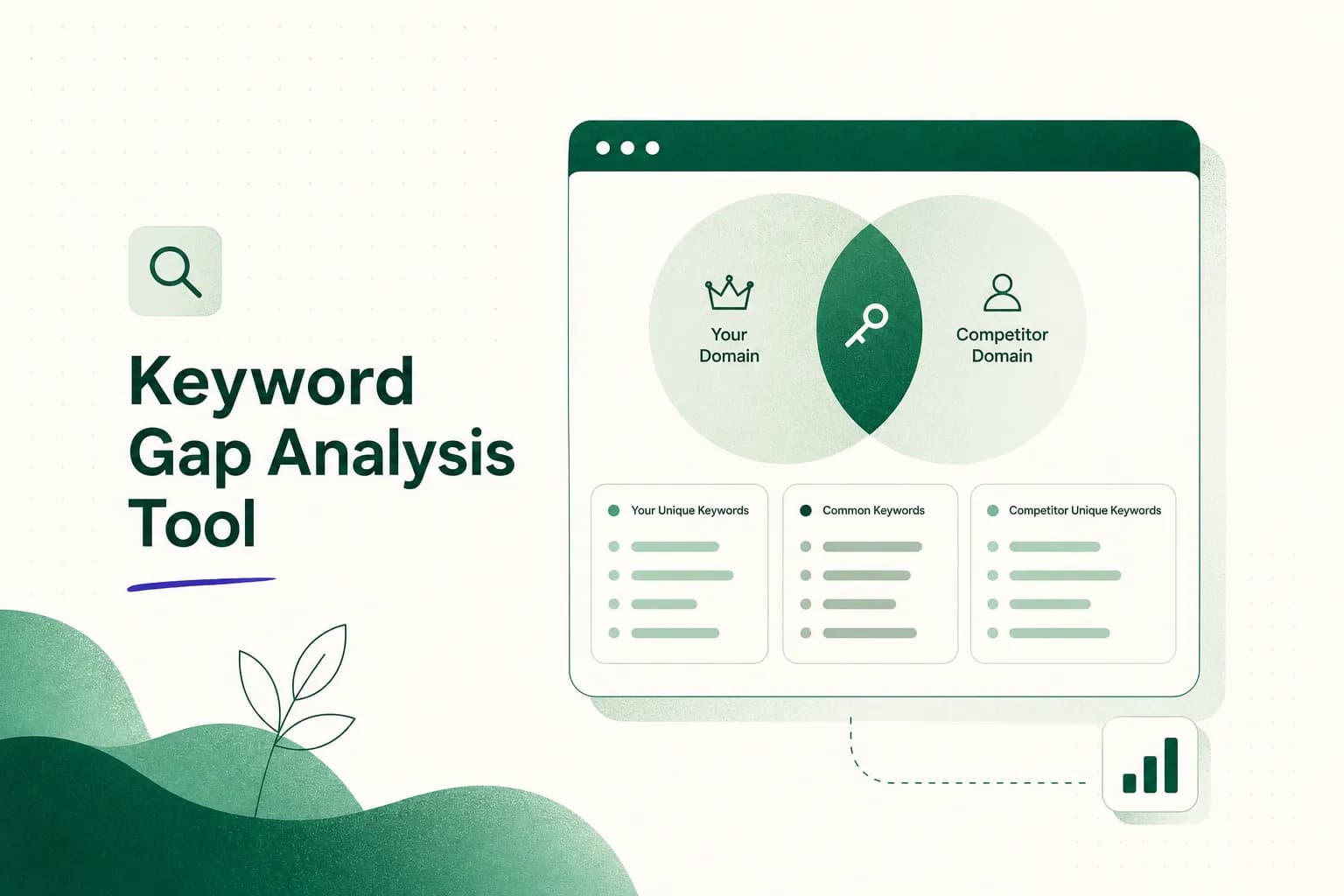
The tool overlays those lists and sorts every keyword into buckets based on who ranks and how well. Keywords only they have. Keywords only you have. Keywords you both have but they beat you on. Keywords several competitors share and you're completely absent from.
That's it.
That's the magic.
The sophistication isn't in the math, it's in the size and freshness of the keyword index behind it, which is why different tools will hand you noticeably different lists for the same two domains.
One important limitation: these indexes are built from crawling, not from your analytics.
They see what they see.
Which is why Google Search Console is the essential second input, and we'll come back to that.
Gap vs Content Gap
People use "keyword gap" and "content gap" interchangeably, and that sloppiness is exactly why so many content plans end up bloated.
A keyword gap is a query-level data point. One specific search term. "Do compost bins smell." That's a row in a spreadsheet.
A content gap is a topic, format, or user-need deficiency that spans multiple queries.
It's the thing the rows are pointing at.
Say your gap report surfaces five missing keywords: "compost bin smell," "why does my compost smell like ammonia," "how to stop compost smelling," "compost bin flies and odour," and "no smell compost bin."
A volume-sorter writes five articles.
Congratulations, you've just built a keyword cannibalization problem where five thin pages fight each other for the same SERP.
Someone doing proper content gap analysis sees one missing guide: "Why Your Compost Smells (and How to Fix It in a Weekend)."
Five rows, one content gap, one page.

The tool gives you queries. Your judgment converts them into topics.
No software has ever done that second step well without help, which is exactly where most beginners lose the plot.
And there's a third data source nobody uses enough.
Google Search Console knows things no competitor tool does, because it's reading your actual performance data rather than guessing.
Filter GSC for queries with high impressions and a miserable click-through rate. Those are pages Google is showing people who then choose someone else.
Then filter for average position 11 to 30. Those are the near-misses, the pages sitting on page two, one decent refresh away from real traffic.
Gap tools find opportunities you've never touched. Search Console finds opportunities you've half-touched and abandoned.
Use both.
Picking Competitors Worth Comparing
Bad competitor selection ruins a gap analysis faster than anything else, and it happens before you've read a single row.
Real Rivals vs Accidental Overlaps
Your business competitors and your SEO competitors are frequently different companies. That's the first thing to make peace with.
A true SEO competitor has an overlapping topical footprint. They write about the same subjects, for the same audience, at roughly the same depth, and they show up next to you in the SERPs repeatedly.
An accidental overlap is a site that happens to share 40 keywords with you out of 90,000. Usually a giant publisher, a marketplace, or a brand so well-known that Google ranks their thinnest page above your best one purely on domain authority and brand demand.
Compare yourself to Amazon and your gap report will helpfully suggest you write about everything ever sold.
Thanks, very actionable.
Here's the practical test.
Before you commit to a competitor, open three or four of the keywords they supposedly beat you on and look at the actual SERP. Does the same competitor appear on multiple queries in your core topic? Is the ranking URL a genuine article, or is it a product page, a category listing, or a forum thread?
Check the SERP overlap with your own eyes, not just the tool's overlap percentage. If their ranking URL is a pricing page and yours would be a guide, the "gap" is fiction.
Different intent, different game.
Sites to generally exclude from your comparison set:
- Marketplaces and directories (Amazon, Etsy, Yelp, Thomasnet) rank through sheer page count and domain strength, not topical expertise you can replicate.
- Brands ranking mainly through product pages give you commercial keywords that require inventory, not content.
- Local-intent dominators rank because of proximity and Google Business Profiles, which no blog post will ever out-rank.
- Massive general publishers (Wikipedia, Forbes, Reddit) have authority you can't borrow and breadth you shouldn't imitate.
How Many Competitors to Include
Three to five competitors is the sweet spot.
Fewer than three and you're mistaking one company's content strategy for a market signal. More than five and your "untapped" list becomes noise, because the wider the net, the more irrelevant fish.
Pick competitors that target the same audience and publish at a similar depth. If you write 2,000-word guides and your comparison set publishes 400-word listicles, half your gaps will be topics that were never worth covering properly in the first place.
Once the report loads, filter aggressively before you analyze anything. Strip out branded terms (their company name, their product names, their founder).
Remove navigational queries like "competitorname login." Kill anything where the ranking result is a video carousel, a shopping pack, or a People Also Ask box that the competitor merely happens to sit beneath.
A 2,000-row export routinely shrinks to 300 legitimately relevant rows after this pass.
That's not a failure of the tool.
That's the filter doing exactly what it should.
Reading Missing, Weak, and Untapped Keywords
Every gap tool uses slightly different labels for the same five ideas, which is annoying but survivable once you know what you're looking at.
The Five Report Categories
These are the buckets your keywords get sorted into, what each one actually means, and what you should do about it.
| Category | What It Means | Typical Volume of Rows | Your Move |
|---|---|---|---|
| Missing | At least one competitor ranks in the top 100; your domain is nowhere on the list. | Usually the largest bucket (40 to 60% of rows) | Assess for topical fit, then cluster into new pages. Highest effort, longest payback. |
| Weak | You rank, but below your competitors. Often positions 11 to 50. | 10 to 25% of rows | Refresh and expand the existing page. Fastest wins live here. |
| Shared | You and competitors all rank on page one. Nobody has a clear edge. | 5 to 20% of rows | Defend. Check who's gaining, strengthen internal links, update for freshness. |
| Unique | Only you rank. No competitor in the comparison set appears. | Often small (under 10%) | Protect it. This is your moat. Build supporting content around it. |
| Untapped | Multiple competitors rank; you're absent entirely. | 5 to 15% of rows | Treat as high-signal. If three rivals all cover it, the topic validates itself. |
Quick check-in: if your "unique" bucket is empty, that's worth sitting with. It means nothing about your content is differentiated from the market, and you're competing entirely on execution rather than positioning.
What to Rank First
Now the part where most people go wrong. They sort by search volume, descending, and start at the top.
Search volume tells you how many people search. It says nothing about whether those people will ever buy from you, or whether you have a prayer of ranking.
It's one variable out of five.
Score each candidate keyword across these dimensions instead:
- Search intent match — does the SERP show the kind of page you'd actually publish? If page one is all product listings and you'd write a guide, you lose before you start.
- Keyword difficulty — read it relative to your own domain, not as an absolute. A KD of 40 is a wall for a new site and a speed bump for an established one.
- Traffic potential — not the keyword's volume, but the total traffic the top-ranking page earns across all its keywords. A 200-volume term whose winner pulls 4,000 monthly visits is a better bet than a 3,000-volume term whose winner pulls 3,100.
- Existing authority — do you already have related pages Google trusts? Gaps adjacent to your current topic authority rank two to three times faster than gaps in unfamiliar territory.
- Business relevance — could someone searching this plausibly become a customer within 90 days? "Free alternatives to [your product]" has volume and terrible relevance.
Then there are the gaps you should deliberately walk away from.
Skip a keyword when the competitor wins because of brand demand (people are searching their name attached to a generic term), when their ranking rests on a backlink profile you can't match, when the ranking URL is a product or pricing page, when a local pack owns the results, or when a SERP feature like a featured video or shopping carousel eats the clicks above the fold.
Those aren't content gaps.
They're structural advantages, and no amount of word count fixes them.
One last thing that trips up beginners: zero-volume keywords are frequently worth targeting. Tools round low numbers down to zero and misreport long-tail questions constantly.
Specific questions ("can you compost citrus peels"), emerging queries that haven't accumulated data yet, and supporting keywords that reinforce a cluster all earn their place in the plan. They convert better than head terms, they feed AI Overviews, and they signal depth to Google.
Volume is a proxy, not the prize.
Turning Gaps Into a Real Content Plan
You've got a filtered list.
Now comes the step that separates a content plan from a content wishlist: attaching a decision to every single row.
New Page, Update, or Ignore
Every surviving keyword gets exactly one of five labels. No row escapes unclassified, because unclassified rows are how backlogs rot.
That last category matters more than it looks.
A plan where everything is a priority is a plan with no priorities.
Grouping Keywords Into One Cluster
How do you know whether eight keywords belong on one page or eight pages?
Don't guess. Let Google tell you.
Open the live SERP for each keyword and compare the ranking URLs. If the same URLs rank for multiple keywords, Google has already decided those queries share intent.
One page.
If the ranking URLs are entirely different sets, those are separate pages.
Three or more shared URLs in the top ten across two keywords is a reliable cluster signal. One or zero shared URLs means you're looking at distinct intents wearing similar words.
This single check prevents the most expensive beginner mistake in SEO: keyword cannibalization, where you publish four pages on near-identical intent, split your own authority four ways, and rank worse than if you'd written one.

Here's what this looks like with real numbers.
A gardening site runs a gap analysis against four competitors and exports 2,014 rows.
Branded and navigational filtering removes 640. Irrelevant intent (product pages, local queries, nursery listings) removes another 810.
What's left: 564 rows.
SERP-overlap clustering collapses those 564 keywords into 12 distinct topics.
Nine map to supporting articles under two existing pillar pages. Two require new pillars entirely. One gets ignored because the SERP is dominated by a retailer's shopping carousel.
Twelve decisions. Not two thousand.
That's a quarter's worth of work you can actually explain to someone.

Doing that clustering by hand takes a solid day, sometimes two. It's also the step people skip when they're tired, which is precisely why so many content plans are just volume-sorted lists in disguise.
This is where a platform like Rankspiral's topical authority engine earns its keep.
Rather than clustering keywords by string similarity (which produces nonsense like grouping "compost bin" with "compost bin for sale"), it clusters based on whether the same URLs already rank for those queries. Same logic as the manual SERP check, run across thousands of rows in minutes.
It then layers a winnability score on top, weighting your existing topical authority against the difficulty of each cluster, and surfaces the position 11 to 30 opportunities first. Those are the pages Google already likes but doesn't quite trust yet, and they typically move within four to eight weeks of a proper refresh rather than the four to six months a brand-new page needs.
Finally: how you measure this.
Ranking position is a vanity metric and a lagging one at that.
Track non-branded impressions in Search Console, because that's the cleanest signal that Google is starting to associate your domain with a topic. Track qualified clicks, meaning traffic to pages that sit on a real conversion path, not your "what is composting" explainer.
And track assisted conversions, because the gap content you publish usually touches a visitor two or three sessions before they convert.
If non-branded impressions climb for three consecutive months, the cluster is working, even if the rankings look flat. Impressions move before positions do.
Keyword Gap Questions, Answered
What is a keyword gap analysis in SEO?
A keyword gap analysis compares the keywords your domain ranks for against those of your competitors to identify search terms where they have organic rankings and you don't. The output is a categorized list of missing, weak, shared, unique, and untapped keywords.
Its real purpose isn't the list itself.
It's to reveal which topics your competitors have built authority around while you weren't looking, so you can decide where to invest content effort next.
How do I find keyword gaps?
Enter your domain and three to five genuine SEO competitors into a keyword gap analysis tool, then review the "missing" and "weak" reports. Filter out branded and navigational terms first, because they'll otherwise make up a third of your results.
Then supplement with Google Search Console.
Filter for queries at average position 11 to 30, and for high-impression pages with poor click-through rates. Those are gaps in your own performance data that no competitor tool can see.
What tool is used for competitor keyword analysis?
The most widely used tools for competitor keyword research are Semrush's Keyword Gap, Ahrefs' Content Gap, Moz, SE Ranking, and Rankspiral, alongside Google Search Console for first-party performance data.
They all perform the same core comparison, so choose based on index size in your market and whether the tool clusters keywords for you. Manual clustering is the most time-consuming part of the workflow by a wide margin.
How do I find keywords my competitors rank for?
Run your competitor's domain through the organic research or organic keywords report of any major SEO platform to see every term they rank for in the top 100, with position and estimated traffic attached.
Sort by their top-performing pages rather than by keyword volume. One high-performing competitor page usually ranks for dozens of related keywords, which tells you more about their content strategy than a flat keyword list ever will.
What is the difference between content gap and keyword gap?
A keyword gap is a query-level data point: one specific search term a competitor ranks for and you don't. A content gap is a topic, format, or user-need deficiency spanning multiple related queries.
Five keyword gaps about compost odour represent one content gap, not five articles. Confusing the two is the fastest route to keyword cannibalization and a blog full of thin, overlapping pages.
How often should you do a keyword gap analysis?
Run a full keyword gap analysis quarterly in stable niches and monthly in fast-moving, competitive spaces like SaaS, finance, or anything AI-adjacent. Add event-triggered checks whenever a competitor launches a major content push, a redesign, or a new product line.
The 2026 caveat: AI Overviews and AI search features have not changed what wins. They still reward topical depth, clear structure, and genuinely people-first content, which is exactly what a well-executed gap analysis surfaces.
Same work, higher stakes.
Stop Collecting Gaps. Start Closing Them.
You don't need another spreadsheet.
You need one thing done this week.
So do this: pick your top three SEO competitors, the ones who genuinely share your audience and publish at your depth. Not the marketplace, not the industry giant, not the brand you're jealous of.
Run the gap report.
Filter out branded terms, navigational queries, and anything where the ranking URL is a product page. Then ignore the missing keywords entirely for now and go straight to the weak bucket.
Find the single keyword sitting at position 11 to 30 with real business relevance.
One keyword.
Refresh that page properly: add the section the winners have and you don't, update the data, point three internal links at it.
Then wait four to eight weeks and check your non-branded impressions.
That's the whole first move.
It's unglamorous and it works, which is a fairly reliable combination in SEO.
And remember what the spreadsheet was always for.
Nobody has ever been rewarded by Google for owning a well-organized keyword export.
The goal was the cluster, the set of pages that collectively makes your site look like it genuinely knows what it's talking about on a subject.
The gaps were never the point.
Closing them into something coherent was.