
Why Everyone Misuses This Free Tool
Here's the awkward truth about Google Keyword Planner: it was never built for you. It was built for advertisers who want to know how much a click on "emergency plumber Brooklyn" is going to cost them.
SEOs just... showed up and started using it anyway.
And honestly? Good call.
It's the only keyword tool pulling numbers directly from Google's own query logs instead of estimating from clickstream data bought off a third party.
But that borrowed-tool origin story explains almost every mistake people make with it. When you use an ads platform to make organic decisions, you inherit an ads platform's definitions.
"Competition" doesn't mean what you think it means. Neither does the forecast tab.
The trap most guides fall into is treating the export button as a finish line. You type in a seed keyword, get 800 keyword ideas, download the CSV, sort by average monthly searches descending, and declare that you now have a content strategy.
You have a spreadsheet. Those are different things.
Google Keyword Planner is the first stage of a keyword research workflow, not the whole workflow. It tells you what people search. It does not tell you what you should write, or whether you could ever rank for it.
So this guide does two jobs. First, it shows you how the tool actually works, including the settings that quietly rewrite your numbers before you've noticed. Second, and more importantly, it separates the paid metrics from the organic decisions, because that confusion is where most keyword research goes sideways.
By the end you'll have a scoring framework, a clustering method, and a clear sense of which Planner numbers to trust and which to treat as vibes. Let's get into the machinery.
How Keyword Planner Actually Works
Most people who "can't access" Keyword Planner gave up at the same screen: Google Ads asking for a payment method.
Understandable. It looks like a paywall.
It isn't.
Is It Actually Free?
Google Keyword Planner is completely free and requires no ad spend, no active campaign, and no credit card charges. You need a Google Ads account, which is free to create, and then you switch to Expert Mode to skip the guided campaign setup that tries to push you into launching ads.
The flow trips people up because Google's onboarding wizard genuinely wants you to build a campaign. Look for the small "Switch to Expert Mode" link, then create your account without a campaign.
Tools and Settings, then Planning, then Keyword Planner.
That's it.
You now have access to the same demand data agencies charge you for.
One honest caveat: accounts with zero spending history see less precise numbers. More on that in a moment, because it matters enormously.
Discover vs Forecast Mode
Keyword Planner is really two tools wearing one coat, and knowing which one you're in saves a lot of confusion.
Discover new keywords is the idea generator. You feed it a seed keyword (or up to ten), or a URL, and it returns hundreds of related keyword ideas with historical search volume, competition ratings, and bid ranges.
This is where 90% of your SEO work happens.
Get search volume and forecasts is different. You paste in a list you already have, and Google returns historical volume plus a projection: estimated clicks, impressions, cost, and conversions if you ran ads on these terms.
That conditional clause is doing heavy lifting. Those Google Ads forecasts assume a campaign exists, with a budget and a bid.
Read a forecast as organic traffic potential and you'll be wrong by an order of magnitude, in whichever direction is least convenient.
Here's the trick that separates decent research from good research: pair a seed keyword with a URL in the same Discover query.
Search "cold brew coffee" alone and you get a generic soup of recipes, machines, and Starbucks queries. Search "cold brew coffee" while also pointing at a competitor's brewing-equipment category page, and Google narrows the idea set toward commercial equipment terms, brand comparisons, and buyer-stage modifiers.
The URL acts as a context filter. Google is essentially asking, "what queries does a page like this one tend to serve?"
Settings That Quietly Change Data
Every number Keyword Planner shows you is the answer to a question that includes filters you may not have checked. Before you trust a single figure, check these.
- Location. Defaults to your country. If you sell to three markets, a nationwide volume figure blends demand you can't act on. Set it to the market you're actually writing for.
- Language. Separate from location. A Spanish-language term in the US is a completely different opportunity from the English equivalent, with different competition.
- Search network. "Google" versus "Google and search partners." Partners includes sites like YouTube and AOL, which inflates volume relative to what you'd see in web search. For SEO, stick with Google only.
- Date range. Default is the last 12 months. Widen it to spot trends, narrow it to catch recent surges. A term that averaged 2,000 searches monthly might have done 8,000 last month and 200 the month before.
- Seasonality. The monthly trend graph is the most underused feature in the tool. "Halloween costumes" at 40,000 average monthly searches is really 480,000 in October and roughly nothing in March.
- Device. Mobile-heavy queries often signal different search intent than desktop-heavy ones. Local and impulse queries skew mobile; research and B2B skew desktop.
Quick check-in: if you've been pulling data on default settings for a global audience while your business serves one city, your entire keyword list may be describing someone else's market.
Worth ten seconds to verify.
Metrics That Lie by Omission
Keyword Planner doesn't lie to you.
It just answers a different question than the one you're asking, with total confidence, in a nice clean column.
Average Monthly Searches Isn't Precise
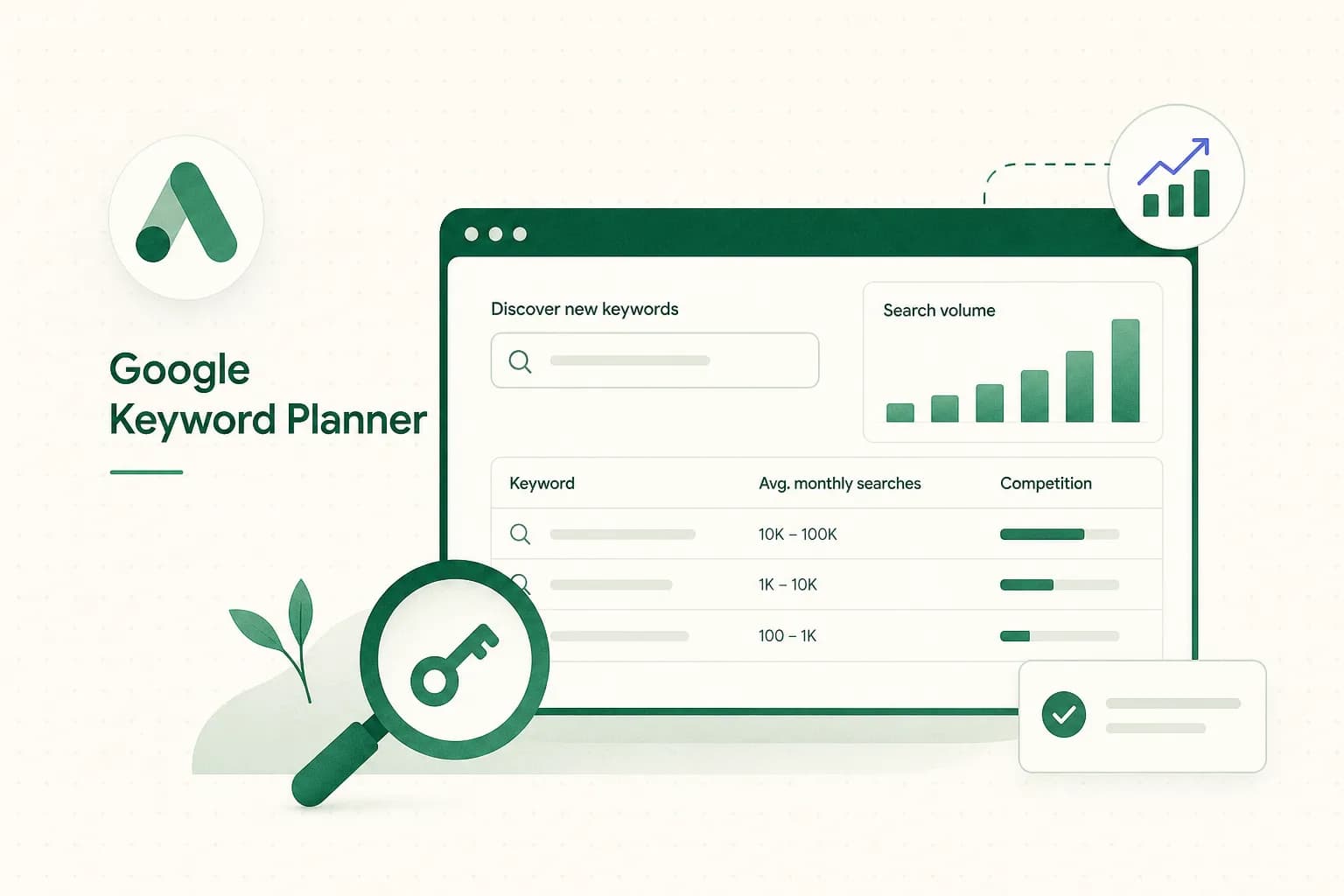
If your Google Ads account has little or no spending history, Keyword Planner shows volume as broad ranges rather than exact figures: 1K to 10K, 10K to 100K, and so on. Those ranges are almost useless for prioritization, because a term at 1,100 searches and a term at 9,800 searches look identical.
Accounts with active ad spend see tighter, specific numbers like "2,400." That's not Google being petty; it's a guard against people scraping precise commercial data for free.
A modest campaign, even a few dollars a day for a couple of weeks, typically unlocks the granular view.
Also worth knowing: average monthly searches is a rounded 12-month average, not a live figure.
It's backward-looking by design.
Competition Means Advertiser Competition
This is the single most expensive misunderstanding in keyword research, and most guides breeze right past it.
The Competition column (Low, Medium, High) measures how many advertisers are bidding on that keyword relative to all keywords in Google's network.
It says nothing, zero, not a thing, about how hard it is to rank organically.
A keyword can show "Low" competition because no advertiser sees commercial value in it, while page one is stacked with Wikipedia, Healthline, and three university domains.
Good luck.
Meanwhile a "High" competition term might have a weak organic SERP full of thin affiliate pages, because the money is in the ads, not the results.
Advertiser competition and organic SEO difficulty are unrelated metrics that happen to share a vibe.
Use the Competition filter to narrow your list, then verify difficulty by actually looking at the SERP.
CPC as a Commercial Intent Signal
The top-of-page bid range (low and high) is the most useful metric in the tool that nobody uses correctly.
Cost per click doesn't tell you traffic value or ranking difficulty.
What it tells you is that real businesses are voluntarily paying real money for that click, which is the most honest commercial-intent signal you'll find anywhere. A $47 top-of-page bid means somebody has done the math and concluded a visitor is worth more than $47.
That's a keyword intent flare, not a difficulty score.
| Metric | What Google Actually Measures | What SEOs Wrongly Assume | How to Use It |
|---|---|---|---|
| Avg. monthly searches | Rounded 12-month average of query volume, shown as a range on low-spend accounts | Precise, current monthly traffic you could capture | Relative sizing only; check the seasonality graph before trusting the average |
| Competition (Low/Med/High) | Density of advertisers bidding, relative to all keywords | How hard it is to rank organically | First-pass filter; confirm real difficulty by inspecting page one |
| Top-of-page bid (low/high) | Range advertisers pay for premium ad placement | Value of an organic click or traffic worth | Commercial intent signal; high bid means buyers, not browsers |
| Forecasted clicks & conversions | Projected ad performance at a given budget and bid | Organic traffic you'd get from ranking | Ignore entirely for SEO unless you're also planning paid |
| Three-month / YoY change | Percentage shift in query volume over the period | Permanent trend direction | Spot seasonality and emerging topics; verify against the trend graph |

From Messy Export to Priority List

You've got 1,400 rows in a CSV. Now what?
This is where most keyword research quietly dies of exhaustion.
The goal isn't to keep everything. It's to throw away roughly 95% of it with good reasons, then rank what survives.
Here's how.
Long-Tail Keywords Hiding in Plain Sight
Head terms hog the top of every export because Google sorts by relevance and volume. The valuable stuff is underneath, and you have to filter for it deliberately.
- Set Competition to Low and Medium only. This won't tell you organic difficulty (we covered that), but it strips out the most commercially saturated head terms and leaves more informational, long-tail keywords standing.
- Filter keyword text by question words. Add "keyword contains" filters for how, what, why, when, can, should, and is. Question queries map cleanly to informational search intent and usually convert into clean H2 sections.
- Filter by modifiers that signal stage. "Best," "vs," "alternative," "review," and "near me" separate comparison-stage searchers from problem-aware ones. Different pages, different angles.
- Filter by word count. Sort or filter for phrases of four or more words. These typically have lower volume and dramatically higher intent specificity, which is exactly the trade you want when your domain is young.
- Scan for entity names you didn't expect. Brands, tools, regulations, and place names appearing in your keyword ideas reveal how your audience actually frames the problem, which is often not how you frame it.
Why You Can't Just Add Up Volumes
Someone in your next meeting is going to say "this cluster has 40,000 monthly searches." They will be wrong, and here's why.
- Google groups close variants in reporting. "Running shoes" and "running shoe" may report the same or overlapping volume because Google's systems treat them as near-identical demand. Adding both double-counts the same humans.
- Plurals, misspellings, and stemmed forms often share a bucket. A cluster of twelve keywords might represent five genuinely distinct queries and seven reflections of them.
- Volume is not clicks. A large share of searches end without a click at all, absorbed by featured snippets, AI overviews, People Also Ask, and map packs. Position one does not equal 100% of search volume.
- The realistic ceiling is a fraction. Even ranking first, you're typically looking at a minority of the reported volume as actual sessions, before accounting for SERP features and paid results above you.
The practical fix: use the highest-volume representative keyword in a cluster as the cluster's size estimate, not the sum. It's conservative and it stops you from promising your boss traffic that doesn't exist.
A Simple Scoring Framework
Here's a scoring system you can build in five columns of a spreadsheet. Score each keyword 1 to 5 across these dimensions, then total for a priority number out of 25.
A worked example, because abstractions are easy to nod along to and hard to apply.
Keyword A: "project management software" at 60,500 average monthly searches. Demand 5, relevance 5, intent match 4, ranking opportunity 1 (page one is G2, Asana, Monday, Wrike, Capterra), business value 5. Total: 20.
Looks fantastic. Is a three-year siege.
Keyword B: "how to write a project handover document" at 720 searches. Demand 2, relevance 5, intent match 5, ranking opportunity 5 (page one is two thin blogs and a Reddit thread), business value 3. Total: 20.
Same score, wildly different timelines.
Which one ships traffic this quarter? The 720-search one, every time.
That's the whole point of scoring rather than sorting by volume: it surfaces the winnable.

Building Clusters That Support Topical Authority
A keyword list is inventory. A topic cluster is architecture.
The gap between them is where most content strategies fall apart.
Sorting your export by volume tells you nothing about page structure. What you actually need is grouping by shared entity (the thing being discussed), parent topic (the broader question it belongs to), and likely page type (guide, comparison, product page, tool, glossary entry).
Take a keyword set around "cold brew." "How long to steep cold brew," "cold brew ratio," and "cold brew grind size" all share the entity cold brew method and the parent topic how to make it.
They're sections of one guide.
"Cold brew vs iced coffee" shares the entity but a completely different parent topic and page type.
Separate page.
One Page or Many?
Use this decision rule, and use it consistently: if two queries return substantially the same top-ranking pages, Google considers them one intent, so build one page. If the SERPs diverge, build two.
It's not a judgment call.
Open both searches, compare the top ten URLs, and count the overlap. Five or more shared results means one page. Two or fewer means separate pages.
In between, use your head and lean toward one comprehensive page if your domain is young.
Ignoring this rule is how you end up with three posts fighting each other for the same query, splitting links and confusing Google's page selection.
That's keyword cannibalization, and it's self-inflicted every single time.
Your pillar page takes the broad parent topic. Supporting cluster pages take the specific, long-tail queries, and they link back to the pillar.
Simple structure, but it only works if the clustering underneath it reflects real SERP behaviour.
Validating Ideas Against Live Results
Keyword Planner's suggestions are inferences from ad data. Reality lives in two other places, and you should check both before committing a month of writing.
The live SERP. Search the term. What page types rank? Is it dominated by video, forums, product listings, or long guides?
If ten results are ecommerce category pages and you planned a blog post, the market has already voted.
Believe it.
Google Search Console. If your site has any history, the Performance report shows queries you're already getting impressions for.
Terms sitting at position 11 to 20 with decent impressions are the cheapest wins available to you, and no keyword tool will ever surface them because they're specific to your site.
Keyword Planner tells you what the market searches. Search Console tells you what the market already associates with you. The second one is usually where next month's traffic comes from.
Where Automation Actually Helps
Manual SERP-comparison clustering works beautifully. It also takes roughly forever, because checking overlap across 400 keywords means 400 searches and a lot of copy-pasting URLs into a sheet.
This is the one part of the workflow where tooling earns its keep.
Rankspiral, for example, clusters keywords by analyzing which pages already rank for them in live SERPs, which is exactly the overlap test described above, just run at scale. A Planner export goes in; a pillar-and-cluster map comes out, with the cannibalization risks already flagged.
The logic is identical to what you'd do by hand. The difference is finishing on Tuesday instead of next month.
Whatever you use, the principle holds: cluster by ranking reality, not by keyword text similarity. Two phrases can look like twins and serve completely different intents.
Frequently Asked Questions
Is Google Keyword Planner still free?
Yes, Google Keyword Planner is free in 2026 and has been since launch. You need a Google Ads account, which costs nothing to create, and you can access the tool without running a campaign or spending money.
The only cost-related limitation: accounts with no spending history see search volume as broad ranges rather than exact figures.
Does Google have a Keyword Planner tool?
Yes.
Keyword Planner lives inside Google Ads, under Tools and Settings, then Planning. It's Google's official first-party keyword research tool and pulls demand data directly from Google's own query logs rather than estimating from third-party clickstream sources.
How to use Google Keyword Planner for keyword research?
Start in Discover new keywords, enter a seed keyword alongside a relevant competitor URL, and set your location, language, and search network to match your real audience. Export the keyword ideas, filter for long-tail and question-style phrases, then score each surviving keyword on demand, relevance, intent match, ranking opportunity, and business value.
Cluster the winners by which pages already rank for them, then write.
The export is the starting point, never the strategy.
Is $20 a day good for Google Ads?
For a small local business or a single tightly-targeted campaign, $20 a day is a workable testing budget, though it's thin in high-CPC industries where a single click can cost $40 or more.
But this is a paid media budgeting question, entirely separate from organic keyword value.
The only SEO-relevant angle: spending anything at all unlocks precise search volume numbers instead of the broad ranges shown to zero-spend accounts.
Is Google Keyword Planner good for SEO?
It's excellent for demand discovery and unreliable for difficulty assessment. Search volume, seasonality trends, and keyword idea generation are genuinely first-party and trustworthy.
Competition ratings, top-of-page bids, and forecasts all describe the paid auction, not organic results. Use Planner to find opportunities, use live SERPs and Search Console to judge them.
Can I use Google Keyword Planner without creating an ad?
Yes, absolutely.
Create a Google Ads account, switch to Expert Mode during setup to skip the campaign wizard, and go straight to the Keyword Planner tool.
No campaign, no budget, no charges.
The interface will keep suggesting you launch ads.
You are allowed to ignore it indefinitely.
What is the best way to find low competition keywords on Google Keyword Planner?
Filter the Competition column to Low, then add keyword-text filters for question words and four-plus-word phrases to surface long-tail terms. That gets you a shortlist fast.
Then verify every candidate manually, because Planner's Competition score reflects advertiser bidding density, not organic SEO difficulty.
Open the SERP: if you see forums, thin affiliate pages, or outdated content in the top ten, that's a genuinely low-competition keyword. If you see nine authority domains, it isn't, whatever the column says.
The One Thing to Do Tonight
Forget the 2,000-word audit.
Do this instead, in about twenty minutes.
Open Discover new keywords.
Enter one seed keyword you genuinely care about, and paste in one competitor URL alongside it. Set location and language to your actual market, search network to Google only, and export the result.
Then filter aggressively.
Low and medium competition, four words or more, question modifiers included. You'll go from several hundred rows to maybe forty.
Score those forty on the five dimensions: demand, relevance, intent match, ranking opportunity, business value.
Twenty minutes, generously.
Pick the top three.
Check each one's live SERP to see whether the ranking opportunity score you gave it survives contact with reality.
Two probably will.
Then write one of them.
Not all three.
One.
Because here's the deadpan bit worth remembering: a spreadsheet full of keyword ideas isn't a content strategy. It becomes a strategy the moment someone is brave enough to decide what not to write, and then actually publishes the thing that's left.
Everything else is just very organized procrastination.