
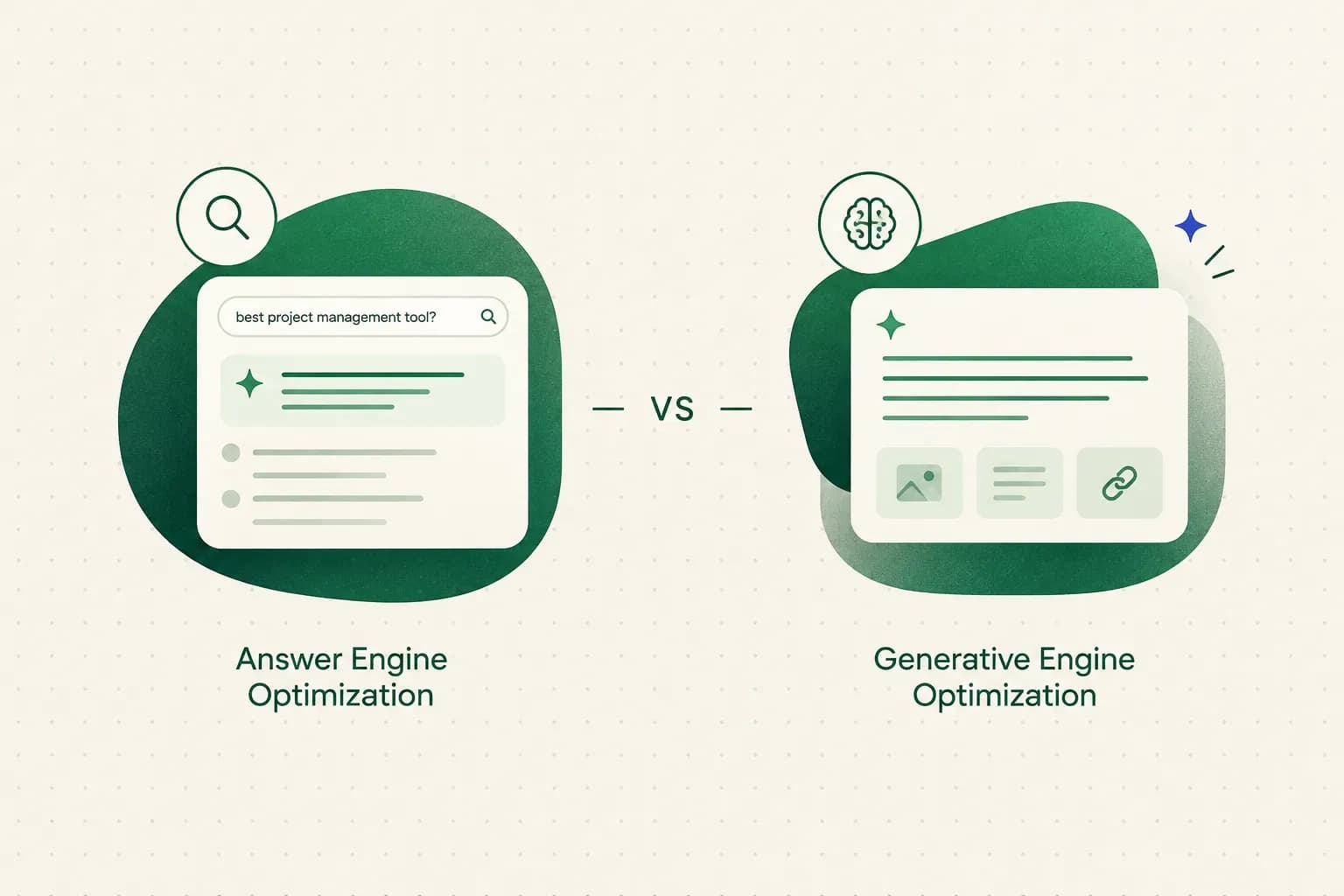
AEO vs GEO: Two Acronyms Walk Into Your Content Strategy
Two acronyms walk into your content strategy.
One wants a featured snippet.
The other wants ChatGPT to quote it, and your boss wants to know which one to fund by Friday.
Here's the quick verdict: answer engine optimization vs generative engine optimization is not an either/or choice.
They're two measurement lenses pointed at the same content foundation. Most guides blur them together because explaining the difference takes effort, and effort doesn't fit in a LinkedIn carousel.
AEO (answer engine optimization) targets direct-answer extraction. That means featured snippets, Google AI Overviews, and the voice assistant reading one tidy answer to someone with flour on their hands.
GEO (generative engine optimization) targets multi-source citation. Your page becomes one of several sources stitched into a synthesized answer on ChatGPT, Perplexity, Gemini, Claude, or Copilot.
Neither replaces SEO.
As of 2026, Google's own guidance on AI features in Search says the same SEO fundamentals apply, which frames generative results as an extension of search rather than a rival discipline.
Same crawling.
Same indexing.
Same "be genuinely useful" rule your English teacher tried to tell you about.
So the real decision isn't "AEO or GEO." It's this: which platform can execute both from one content base, and then prove it moved revenue instead of just nudging a visibility score?
Quick takeaway: Write once, measure twice, then follow the money. Visibility is nice. Checkouts pay the invoices.
That's what this guide answers.
First we'll separate the two disciplines cleanly, then map which engines reward which tactics, and finally compare six AI SEO platforms on whether they can actually do the work and track the results.
AEO vs GEO at a Glance
Short on time?
This table is the whole article in miniature.
Bookmark it, screenshot it, or print it out and tape it above your desk like a motivational cat poster.
| Dimension | AEO (Answer Engine Optimization) | GEO (Generative Engine Optimization) |
|---|---|---|
| Primary engines targeted | Google featured snippets, People Also Ask, Google AI Overviews, Google AI Mode, voice assistants | ChatGPT, Perplexity, Gemini, Claude, Copilot |
| Content format required | Tight 40-60 word answers, question-based headings, FAQ and how-to schema | Comprehensive, well-sourced sections with original data and clear entities |
| Ranking signal | Structured, extractable answer from a single page | Topical authority and citability across multiple sources |
| Success metric | Snippet ownership, AI Overview inclusion rate, position | Citation frequency, AI brand mentions, sentiment, share of voice |
| Measurement difficulty | Low to moderate (standard rank tracking covers most of it) | High (sampled prompts, answers that change run to run) |
| Typical tools | Rank trackers, schema validators, SERP feature tracking | Prompt tracking and citation monitoring tools (Frase, Semrush AI Visibility, Arvow) |
| Where it wins | Structured snippet extraction, FAQ schema, concise definitions, voice search optimization | Being cited inside a synthesized, multi-paragraph AI answer on third-party engines |
| Proves revenue on its own? | No | No |
Notice that last row.
Neither discipline proves revenue alone.
Proving that a snippet or a ChatGPT citation turned into a sale requires a platform layer that neither acronym describes: click tracking tied to specific pages and checkouts.
That gap is the whole reason this guide exists. We'll close it in the platform comparison further down.
What Each Discipline Actually Optimizes For
Here's the simplest way to hold the difference in your head.
AEO is about being the answer.
GEO is about being one of the sources behind the answer.
Same content effort, different distribution game.
Let's unpack both.
Answer Engine Optimization: Winning the Direct Answer
Answer engine optimization structures content so a single page can be lifted verbatim into a featured snippet, an AI Overview, or a voice answer.
The engine wants one clean block it can quote without rewriting.
Your job is to hand it that block on a silver platter.
In practice, AEO looks like this:
- Question-based H2s and H3s that mirror how people actually phrase searches ("How long does sourdough starter last?").
- Scannable definitions in the first 40-60 words under each heading, before any nuance or backstory.
- Schema markup (FAQ, HowTo, Product, Recipe) so the engine understands what each block is.
- Lists and tables that can be extracted as-is for "steps" and "best X" queries.
AEO's home turf is Google's own SERP: featured snippets, People Also Ask, Google AI Overviews, and now Google AI Mode. Featured snippet optimization is the oldest member of this family, and its habits (answer first, explain second) carry straight over into AI Overviews.
Think of AEO as writing for a very impatient reader who only reads the first sentence. Because, functionally, that's what the extraction layer is.
Generative Engine Optimization: Winning the Citation
Generative engine optimization writes for retrieval across a model's training data and its live-browsing layer. On ChatGPT, Perplexity, Gemini, or Copilot, your page is typically one of 5-10 sources the model reads, blends, and summarizes into a fresh answer.
The model isn't copying your paragraph.
It's deciding whether you're worth citing at all.
So GEO rewards different things:
- Topical authority: covering a subject deeply across a cluster of pages, not one lonely post.
- Original data: numbers, tests, and findings a model can't get anywhere else.
- Citability: clearly attributed claims, named entities, and specific figures a model can confidently quote.
- Entity optimization: making it obvious who you are, what you sell, and what you're an authority on.
Large language model optimization (another name you'll see floating around, along with "LLM visibility" and "ChatGPT SEO") is really the same idea.
Be the kind of source a model wants to quote.
Structure helps, but substance carries more weight.
Quick check-in: still with me?
Good, because here's the twist most articles miss.
At the sentence level, it's a tie.
Both disciplines reward clear, factual, well-organized prose. A crisp definition followed by a well-sourced explanation serves the snippet extractor and the generative model.
The split happens in distribution, not drafting.
That means you don't need two content teams writing two versions of every article. You need one well-built article, then two different ways of checking whether it worked.

So who wins?
For Google's own SERP: AEO.
For third-party AI chat traffic: GEO.
This is a split decision, not a draw by default.
Which one matters more depends entirely on where your buyers actually ask their questions, which is exactly what the next section maps out.
Where Each Strategy Actually Wins: Engines, SERP Features, and Content Rules
Different engines, different appetites.
Some want one perfect bite-sized answer.
Others want a buffet of sources they can remix.
Here's how the major surfaces break down in 2026.
| Engine / SERP Feature | Leans AEO or GEO? | Why | What to Give It |
|---|---|---|---|
| Google AI Overviews | AEO | Favors structured, schema-rich, extractable answers for short factual queries | Direct answer near the top of each section, FAQ schema |
| Google AI Mode | AEO with GEO overlap | Runs on Google's index but handles longer, multi-part questions conversationally | Question-based headings plus deeper supporting sections |
| Featured snippets | AEO | Classic single-source extraction from one ranking page | 40-60 word definitions, numbered steps, comparison tables |
| ChatGPT | GEO | Synthesizes across multiple sources rather than lifting one block | Original data, clear entities, quotable specifics |
| Perplexity | GEO | Shows multiple numbered citations per answer from live retrieval | Well-cited, current sections a model can pull mid-article |
| Gemini | GEO with AEO overlap | Generative chat experience, but benefits from strong Google search presence | Topical depth backed by solid traditional rankings |
| Claude | GEO | Generative synthesis; rewards clear, authoritative sources when browsing | Comprehensive, factual coverage with attributed claims |
| Copilot | GEO | Generative answers with source citations drawn from web results | Citable sections and strong entity signals |
Let's translate that grid into plain English.
AEO wins Google AI Overviews and classic snippets because Google still leans toward structured, single-source extraction when the query is short and factual.
"What temperature to bake salmon" doesn't need five perspectives.
It needs one correct number, fast.
GEO wins ChatGPT and Perplexity because these engines synthesize across several ranking pages instead of lifting one block verbatim.
Ask Perplexity "which CRM is best for a 10-person sales team" and you'll get a stitched answer with multiple citations.
Being one of those citations is the GEO game.
The content format differs too, and this is where people get tripped up:
- AEO rewards tight 40-60 word definitional answers placed near the top of the page or section.
- GEO rewards comprehensive, well-cited sections that a model can pull from anywhere, including the middle of a long article.
Good news... those two formats coexist happily on the same page.
Lead each section with the short answer (AEO), then back it with depth, data, and sources (GEO).
That's content extractability and citability in one pass.
Verdict: No universal winner. Ecommerce and local queries lean AEO. Informational and comparison queries lean GEO. Most sites need both running on the same content.
If you sell garden tools, "how deep to plant garlic" is an AEO play. "Best cordless hedge trimmer for small gardens" is a GEO play.
Same blog, same writer, different distribution path.
Measuring Success: Direct-Answer Visibility vs Generative Citations
Writing the content is the fun part.
Measuring it is where things get... interesting.
And by interesting, we mean "slightly murky in ways vendors would rather you didn't ask about."
AEO is the easy one to measure.
You track snippet ownership, AI Overview inclusion rate, and position changes. Most SEOs already own tools that cover this, since featured snippets and AI Overviews show up as SERP features in standard rank trackers.
GEO is measured through prompt tracking.
A tool samples a set of prompts across ChatGPT, Perplexity, Gemini, and Claude, then counts how often your brand or URL gets cited.
Better tools layer on sentiment (are you mentioned positively?) and share of voice (how often do you appear versus competitors?).
So far, so sensible.
But here's the content gap most competitors skip entirely.
A high AI visibility score can still mean zero clicks.
Generative answers are frequently zero-click experiences. The user gets the summary, nods, and moves on.
Your brand got cited, your dashboard turned green, and your revenue did absolutely nothing.
That's why visibility and traffic must be reported separately.
A citation is an awareness metric.
A click is a traffic metric.
A checkout is a business metric.
Bundling them into one "AI score" is like judging a restaurant by how many people walked past the window.
Takeaway: Report AI visibility, organic clicks, and conversions as three different numbers. If a tool merges them, ask what it's hiding.
Then there's the transparency problem.
AI search analytics is a young category, and few AI visibility vendors disclose how often prompts are refreshed or whether citation counts are reproducible. Generative engines give different answers to the same prompt on different runs, so a single sample can be wildly misleading.
Before you buy any AEO tools or GEO software, ask the vendor three questions:
- How often are prompts re-run? Daily, weekly, or "whenever"?
- How many samples per prompt? One run is an anecdote, not a metric.
- Can I see the raw answers? If you can't audit the citation, you can't trust the count.
So which measurement approach wins?
A tie, with a catch.
Both direct-answer visibility and generative citations matter.
But neither one tells you about revenue.
Revenue requires click-to-checkout attribution layered on top, connecting a specific article and a specific link to a specific sale. Almost no AEO or GEO tool provides that natively, which is exactly the lens we'll use to compare platforms next.
Which Platform Actually Executes Both (and Tracks the Money)
Time to name names.
We compared six AI SEO platforms on what actually matters: research quality, AI visibility tracking, content production, human review, revenue attribution, and pricing (updated for 2026).
| Feature | RankSpiral | Frase | Semrush AI Visibility | Arvow | Outrank | RankPill |
|---|---|---|---|---|---|---|
| SERP-based research | Live Google SERP clustering into pillars and clusters, plus winnability scoring for quick wins | Researches top-ranking pages to build briefs and topic clusters | Prompt research; SEO toolkit priced separately | Automatic keyword research | Live search volume and difficulty data | Keywords by traffic and difficulty |
| AI visibility tracking | No standalone prompt-level tracking; tracks Google rankings (100 to 3,000 keywords by plan) | ChatGPT, Perplexity, Claude, Gemini, Google AI | ChatGPT, Google AI, Gemini, Perplexity with sentiment and share of voice | ChatGPT, Perplexity, Claude, Gemini, Grok, Google AI (6 credits per prompt) | AI visibility features and ChatGPT mention claims | Claims Google and AI search optimization |
| Content production | 30 to 220 articles/mo, 3,000+ words, six-pass process | AI writing in brand voice with SEO and GEO scoring | Monitoring only (content toolkit sold separately) | AI Article Writer and Autoblog, credit-based | 30 articles/mo on autopilot | One article per day |
| Human review / quality | Style pass and fact-check on every plan; every change approval-gated | Content Guard drafts decay fixes for approval | N/A | Human-plus-AI service from $2,000/mo | Human Curated Service $1,399/mo add-on | Not emphasized publicly |
| Revenue attribution | Cookie-free click tracking per article and per link to checkout | Not emphasized | ROI attribution on enterprise tier; no per-link click tracking | Not emphasized | Not emphasized | Not emphasized |
| Back-catalogue repair | Retrolink: weekly checks, link retrofits, dead product link swaps | Content decay monitoring | AI readiness site audits | AI SEO Editor | Unlimited AI rewrites | Not offered |
| Starting price | $99/mo (Starter); $149/mo Growth | $39/mo annual, $49/mo monthly | $99/mo per domain (annual) | $39/mo annual promo (Solo) | $99/mo for 30 articles | $99/mo (Business) |
RankSpiral: Best Overall
RankSpiral wins on revenue attribution, and it isn't close.
Its lightweight, cookie-free, no-IP tracking snippet ties every product, affiliate, and internal link back to the exact article and click that produced it.
None of the five competitors offer per-link click-to-checkout tracking natively.
Quality holds up too.
In an independent comparison, RankSpiral's content scored 84/100, versus 87/100 for Ahrefs' human editors and roughly 40/100 for other AI tools.

Part of that comes from the dedicated style pass that strips out AI cadence.
It's standard on every plan, not a $1,399/month add-on like Outrank's human review.
Plans run from $99/month (1 site, 30 articles) to $599/month (10 sites, 220 articles), with a 3-day free trial and two free articles, no card required.
Honest limitation: RankSpiral doesn't run standalone prompt-level citation tracking across ChatGPT or Perplexity the way Frase or Semrush do. It grounds research in live Google SERPs instead, then pairs that with Retrolink to retrofit money links and swap dead product links in old posts.
The Rest of the Field
- Frase wins on built-in AI visibility: SEO and GEO scoring on the same draft, plus cross-engine tracking (ChatGPT, Perplexity, Claude, Gemini) in one workflow. Genuinely strong, from $39/month annually, though engine coverage and credits scale by plan.
- Semrush AI Visibility wins on measurement depth and enterprise reporting: prompt research, sentiment, share of voice, competitor gaps. But it's monitoring, not a content pipeline, from $99/month per domain.
- RankPill and Outrank win on raw automation speed and entry price ($99/month for roughly 30 articles). Neither separates AEO from GEO measurement or retrofits a back catalogue with tracked links.
- Arvow wins on breadth: content, backlinks, local SEO, and AI visibility in one suite. The credit system (15 credits per article, 6 per visibility prompt) makes true cost comparison tricky, and setup is configuration-heavy.
Overall winner for most buyers: RankSpiral. It's the only platform pairing live-SERP content production with per-link revenue tracking and automated back-catalogue retrofitting. If third-party AI engine monitoring is a hard requirement, pair it with a dedicated citation tracker.
Who Should Choose What
Bottom line first: most sites should run a combined AEO and GEO approach and pick a platform based on what it can prove, not what it promises.
Here's how that shakes out for specific situations.
- Choose AEO-first tactics if you run local service pages, FAQ-heavy support content, or recipe and how-to sites competing for featured snippets and Google AI Overviews. Your wins come from tight answers, schema, and question-based headings.
- Choose GEO-first tactics if your buyers research on ChatGPT or Perplexity before converting. SaaS comparison content and research-heavy B2B niches lean this way, because buyers ask long "which is better for my team" questions that generative engines love to synthesize.
- Choose a combined approach if you're running an ecommerce store, an affiliate site, or an agency (which is most of you). Pick RankSpiral if you need product links tracked all the way to checkout and a stale blog rewritten, not just a fresh pile of new articles stacked on top of the old ones.
- Choose Frase if standalone AI-citation tracking across five engines is the single most important feature on your list, and you're comfortable running ecommerce link tracking and catalogue sync elsewhere.
- Choose Semrush AI Visibility if you're an enterprise team that already owns a content pipeline and just needs measurement, prompt research, and competitive intelligence layered on top. Budget for the extra toolkits, because costs climb fast.
- Choose RankPill or Outrank if budget and daily publishing volume matter more than revenue attribution or back-catalogue repair. They're fast and affordable. Just don't expect them to tell you which article sold the blender.
- Choose Arvow if you want one broad suite covering content, backlinks, local SEO, and AI visibility, and you have the patience to configure it and track credit spend.
One more scenario, because it comes up constantly with store owners.
If you specifically need a tool built around retrofitting an existing Shopify catalogue with tracked money links, none of the alternatives really address it.
RankSpiral's Retrolink checks existing posts weekly, flags ranking slips, and suggests one-click swaps for discontinued products.
Its CSV and Shopify sync keeps product URLs current without manual pasting.
Think of the founder with 60 dusty blog posts from 2022, half linking to products that no longer exist.
Publishing 30 new articles won't fix that.
Retrofitting the old ones will.
Rule of thumb: If you can't answer "which article made us money last month?", fix that before buying another visibility dashboard.
FAQ: AEO, GEO, and SEO in 2026
Is SEO dead now with AI?
No, SEO is very much alive in 2026.
Google's guidance treats AI features like AI Overviews and AI Mode as part of Search, and says the same SEO fundamentals still apply.
Pages that rank well, load fast, and answer questions clearly are the same pages AI engines pull from.
What changed is the scoreboard.
You now track citations and AI brand mentions alongside rankings and clicks.
Is AEO similar to SEO?
Yes, AEO is a subset of SEO, not a separate discipline with its own rulebook. It focuses specifically on structured, extractable answers: featured snippets, People Also Ask, voice results, and AI Overviews.
If you're already writing question-based headings and answering them in the first sentence, congratulations.
You've been doing AEO without the acronym.
What are the four types of SEO?
The four commonly cited types are technical, on-page, off-page, and local SEO.
Technical covers crawlability and site speed.
On-page covers content and structure.
Off-page covers links and mentions.
Local covers maps and location-based results.
AEO and GEO layer on top of these four.
They don't replace any of them.
Is SEO or SEM better?
Run both if you can, because they solve different problems.
SEM buys placement through paid ads, so results start immediately and stop the moment you stop paying.
SEO, and AEO and GEO by extension, earns placement that compounds over time.
Asking which is better is a bit like asking whether renting or owning is better.
Depends on your timeline and your wallet.
Is AEO the same as GEO?
No, AEO and GEO are different.
AEO targets single-source extraction on Google's own surfaces, where one page supplies the answer.
GEO targets multi-source citation across third-party generative engines like ChatGPT and Perplexity, where your page is one of several sources blended together.
Same writing habits, different distribution, different metrics.
What is the difference between AEO, GEO, and SEO?
SEO is the foundation, AEO optimizes for being the extracted answer, and GEO optimizes for being cited in generated answers.
SEO gets you indexed and ranked.
AEO shapes content so Google can lift it into snippets and AI Overviews.
GEO builds the topical authority and original data that makes models want to quote you.
One content base serves all three.
Only the measurement changes.
Should I focus on AEO or GEO in 2026?
Don't choose one.
Build one content foundation, measure direct-answer visibility and generative citations as separate metrics, then let the business outcome decide where to invest more.
That means clicks, leads, and checkouts, not just a visibility score.
If your AEO wins drive sales and your GEO citations don't (or vice versa), the data will tell you.
You just need click-level attribution to hear it.
How do I optimize my website for ChatGPT and Google AI Overviews?
Start with strong traditional SEO, then structure every page for both extraction and citation. The same page can win in both places if you build it in the right order.

Do those six things consistently and you're covering AEO, GEO, and SEO in one workflow.
Then follow the money and double down on whatever actually pays.