

Google doesn't reward websites that publish about everything. It rewards websites that prove they know one thing deeply.
That proof is topical authority, and it's the reason a 30-page niche site can outrank a 3,000-page media conglomerate for specific queries.
This isn't a theory piece. It's a working playbook. You'll get the topical map template, the internal linking counts, the measurement formulas, and the pruning decision matrix. Everything you need to go from "random blog posts" to "this site owns this topic" in Google's eyes. Whether you're a solo operator or running a content team of twelve, the mechanics are the same.
Why Random Blog Posts Don't Rank Anymore
Topical authority is Google's trust signal that a site comprehensively covers a subject. It's not Domain Authority (that's a Moz metric, and Moz will happily sell you tools to track it). It's not Page Authority either, which is a single-URL signal. Neither DA nor PA measures topic depth.
Google does.
And since the helpful content update, it measures it aggressively.
The 2024 leaked API documentation confirmed what SEOs had suspected for years: Google scores sites on "information gain," essentially whether your content adds something new or just rehashes what's already ranking. Content quality signals reward sites that demonstrate entity-level understanding of a topic, not sites that published one decent article and moved on to something else.
Here's the contrast. The old model was "publish and pray." You'd write one article about project management software, target a keyword, maybe build a few backlinks, and hope. The pillar-cluster model flips that entirely.
A site with a pillar page plus 11 subtopics covering everything from Gantt chart comparisons to sprint planning templates captures 4 to 8 times more keyword surface area. That's not a guess. That's what topic clusters do when they're built correctly.
Now, honest expectations. Because I know someone is reading this thinking they'll see results by Friday. Measurable topical authority gains typically appear in Google Search Console at 90 to 120 days for a focused cluster. Full topic ownership in a competitive niche? That's 6 to 12 months.
If you're looking for a shortcut, I don't have one. But I do have a system.
Build Your Topical Map First
A topical map is the blueprint that turns "we should write about this" into a structured content hub with clear keyword targets, search intent labels, and publishing priorities. Without it, you're guessing.
And guessing at scale just means you produce expensive content that cannibalizes itself.
From Seed Keyword to Full Cluster
Step 1: Seed keyword extraction. Pull your top 5 ranking pages from GSC. Export their "Queries" tab. Cluster those queries by parent topic using Ahrefs Topic Clusters or Semrush's Keyword Magic Tool grouped by parent topic. You'll immediately see which topics you've accidentally started covering and which ones have obvious gaps.
Step 2: Gap analysis. Compare your keyword coverage against the top 3 competitors using Ahrefs Content Gap. Flag any subtopic where a competitor has 3 or more ranking pages and you have zero. Those gaps are where your topical authority leaks.
Every unfilled gap tells Google that the competitor understands the topic better than you do.
Step 3: Map the hierarchy. Here's a concrete example. Say your pillar topic is "Wireless Audio." One cluster under that pillar is "Earbuds." Under earbuds, you have an ANC subtopic. And under that, a leaf page targeting "best gym earbuds for small ears." That maps to 1 pillar page, 3 cluster pages, and 7 leaf pages. That's 11 pages total, your minimum viable pillar.
Below that threshold, you don't have a content hub. You have a content suggestion.
Small-site note: If you're a solo operator, build ONE complete pillar before starting a second. Partial coverage signals topic abandonment, not authority. Google doesn't give partial credit.
The CSV Template (Column by Column)
Your topical map lives in a spreadsheet. Here are the exact columns you need:
- Pillar_Topic — the broad parent subject (e.g., "Wireless Audio")
- Cluster_Slug — the subtopic grouping (e.g., "/earbuds/anc/")
- Target_Keyword — the primary keyword for this specific page
- Search_Volume — monthly search volume from your preferred tool
- Keyword_Difficulty — KD score for prioritization
- Search_Intent — Info, Comp (comparison), or List
- Assigned_Writer — who's responsible
- Status — Draft, In Review, Published, Needs Update
- Internal_Link_Target — which existing page this new page should link to
- Priority_Score — a simple formula: (Search Volume ÷ Keyword Difficulty) × intent weight
This CSV becomes your single source of truth. Every editorial decision, from "what do we write next" to "what do we prune," references it.
Internal Links Are Your Authority Wiring
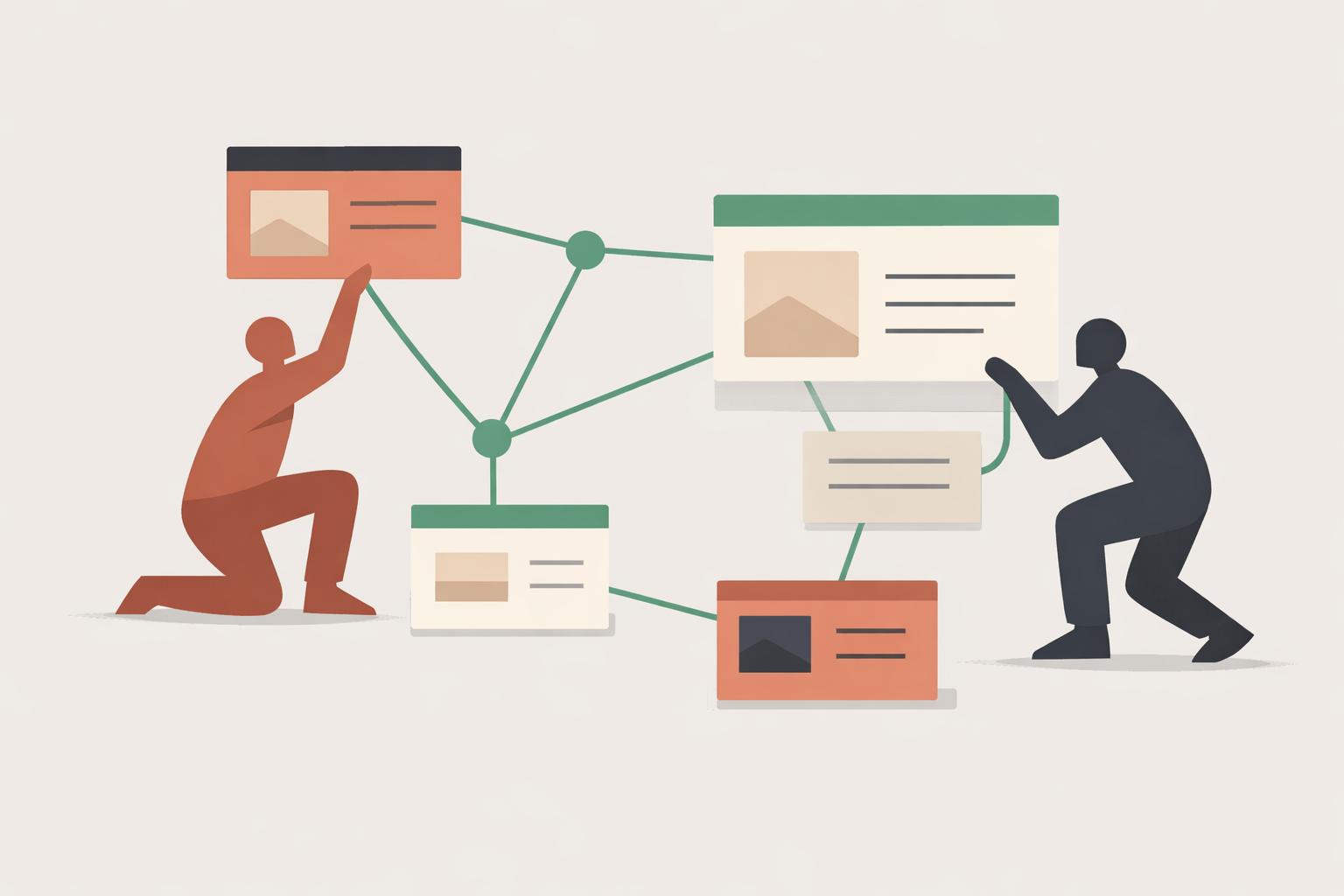
You can have the best topical map in the world, but if your internal linking strategy is broken, Google can't see the relationships between your pages. Internal links are how you tell Google "these 11 pages are one cohesive body of knowledge, not 11 unrelated articles that happen to live on the same domain."
Think of them as the wiring inside the walls. Nobody sees them, but nothing works without them.
Exact Link Counts That Move the Needle
Your pillar page should link out to every cluster page. Target 8 to 15 contextual links embedded in the body copy. Not a navigation widget at the bottom. Not a "related posts" sidebar. Contextual, in-paragraph links with descriptive noun-phrase anchors.
Each cluster page links back to the pillar AND to 2 to 3 sibling cluster pages. This creates a mesh topology, not a rigid tree. Google can crawl laterally across related subtopics, which reinforces the semantic SEO signal that these pages belong together.
Leaf pages get 3 internal links minimum: 1 link up to their cluster parent, 1 link to the pillar, and 1 lateral link to a related leaf page. Anchors should be descriptive noun phrases. "Active noise cancellation comparison" is good. "Click here" is a waste of a link.
Here's what most teams get wrong: retroactive linking. When you publish a new leaf page, you need to go back and add a contextual link from the pillar and at least one existing cluster page pointing to the new content. Most teams skip this entirely, and it's a measurable ranking drag.
The new page sits orphaned until someone remembers it exists.
Rankspiral's Smart Internal Linking engine handles retroactive linking automatically across the full content library, surfacing a Link Opportunity Score per article so editors can prioritize without running a manual audit every time they hit "publish."
Breadcrumbs, Taxonomy, and Schema
Breadcrumb schema (BreadcrumbList JSON-LD) tells Google the hierarchy explicitly. Here's what the markup looks like for a leaf page:
{

"@context": "https://schema.org",

"@type": "BreadcrumbList",

"itemListElement": [

{"@type": "ListItem", "position": 1, "name": "Home", "item": "https://yoursite.com/"},

{"@type": "ListItem", "position": 2, "name": "Wireless Audio", "item": "https://yoursite.com/wireless-audio/"},

{"@type": "ListItem", "position": 3, "name": "Earbuds", "item": "https://yoursite.com/wireless-audio/earbuds/"},

{"@type": "ListItem", "position": 4, "name": "Best Gym Earbuds for Small Ears"}

]

}
This tells Google: Site → Pillar → Cluster → Leaf. It's a direct entity relationship signal that reinforces your topic cluster structure.
If you're not using breadcrumb schema on every page in your content hub, you're leaving topic visibility on the table.
Measuring Topical Authority (With Real Formulas)
Here's where most topical authority guides get vague. "Check your rankings" isn't a measurement strategy. You need specific KPIs with formulas you can actually plug into a spreadsheet, track monthly, and use to make decisions. Here are the three that matter, plus the timeline for when you should expect movement.
Three KPIs That Actually Matter
Topic Traffic Share
The formula: (your site's estimated traffic for target topic keywords) ÷ (total estimated traffic across all ranking sites for those keywords) × 100.
Pull this from Ahrefs Site Explorer, filtered by your topic keyword list from the topical map CSV. This gives you traffic share by domain for your specific topic. Benchmark it monthly.
If you started at 2% and you're at 7% after six months, your topical authority strategy is working. If you're flat, something in your cluster is broken.
Cluster Keyword Capture Rate
The formula: (number of target cluster keywords where your site ranks positions 1 to 20) ÷ (total keywords in your topical map CSV) × 100.
Track this in a Google Sheet updated monthly via Semrush API export or Ahrefs CSV. This is your most actionable metric because it tells you exactly how much of your planned topic you've actually captured in search results.
A healthy cluster should hit 40 to 60% capture rate within 6 months.
AI Overview Appearance Rate
This is the 2026 answer engine optimization signal most teams are ignoring. In GSC, filter by "Search type: Web" plus "Appearance: AI Overviews." Track what percentage of your cluster keywords trigger an AI Overview where your site is cited.
This metric matters because AI Overviews are eating traditional clicks. If Google's AI is citing your content, you've achieved something beyond rankings.
You've become a knowledge graph source for your topic. That's the deepest form of topical authority there is.
Realistic KPI timeline: Month 1 to 2 is your baseline. Month 3 is when you should see first cluster keyword capture rate movement (expect +10 to 15%). Month 6 is when topic traffic share gains become visible. Month 12 is when AI Overview appearances start showing up for your primary cluster.
Red-flag metric: if a cluster page has 200+ impressions but CTR under 1%, the title and meta description are broken. Fix them before publishing more leaf pages. Adding content to a cluster with a broken entry point is like building rooms onto a house with no front door.
Prune or Expand? The Decision Matrix
Not every page on your site deserves to exist. Some pages actively hurt your topical authority by diluting your cluster's focus or cannibalizing keywords from stronger pages. Content pruning isn't about deleting things for fun.
It's about making the remaining content stronger. Here's the decision matrix.
| On-Topic (Fits Your Cluster) | Off-Topic (Doesn't Fit) | |
|---|---|---|
| Traffic Growing | GROW — Expand with subtopics, add leaf pages, build deeper | ISOLATE — Keep the page but don't link it into your main cluster. It earns traffic on its own terms. |
| Traffic Declining | OPTIMIZE — Refresh content, consolidate with similar pages, update internal links | PRUNE — 301 redirect to nearest relevant page, or noindex. It's dead weight. |
The consolidation rule: if two pages target keywords with more than 60% keyword overlap and neither ranks in the top 20, merge them. Redirect the lower-authority URL to the stronger one. Combine the best sections from both. Update every internal link pointing to the deleted URL. Don't chain redirects.
Link equity preservation checklist: before any 301, export all internal links pointing to the URL (a Screaming Frog crawl takes 5 minutes). Update them to point directly to the destination URL. Redirect chains bleed PageRank and slow crawl efficiency.
Pruning cadence: enterprise teams should run a quarterly content audit using Screaming Frog plus a GSC export. Solo operators? Every 6 months is plenty. Over-auditing a thin site wastes time you should spend publishing.
Concrete example: a SaaS blog with 47 posts, 12 of which cover "project management tips" with overlapping intent. Consolidate those 12 into 3 focused cluster pages and a pillar. 301 the rest. Expected outcome: the pillar enters the top 10 within 60 to 90 days.
I've seen this exact pattern play out multiple times. The math works because Google finally has one strong page to rank instead of twelve weak ones fighting each other.
Scaling With AI Without Tanking E-E-A-T

Yes, you can use AI to produce content at scale. No, you can't just hit "generate" and publish. The sites getting hammered by Google's quality systems in 2026 aren't using AI. They're using AI lazily.
The difference between a site that scales with AI and a site that tanks its E-E-A-T is a review workflow that takes 30 minutes per article. That's it.
The Safe AI Content Workflow
Here's the four-step process that keeps you on the right side of Google's quality raters:
- AI draft generated with live web research. The draft should pull from current sources, not just training data. This is table stakes in 2026.
- Human editor checks factual claims against primary sources. Every statistic, every product spec, every "according to" gets verified. This is where most teams cut corners and pay for it later.
- Add one original insight or data point not found in competitor pages. This is your information gain signal. A proprietary screenshot, a test result, a quote from an expert you actually talked to. Something Google's crawlers can't find anywhere else.
- Flag as "AI-assisted" in your CMS metadata for internal tracking. Never for public display. This is for your editorial team's quality control, not for Google.
E-E-A-T preservation checklist for AI drafts: named author with a bio and real credentials. At least one first-person experience signal ("we tested," "in our audit"). An outbound citation to a primary source like a study or official documentation. Publish date plus last-reviewed date visible on the page.
Miss any of these and you're publishing content that looks exactly like what it is: machine-generated filler.
Rankspiral's five-pass pipeline includes an AI-phrase ban list that strips out "delve," "landscape," "it's worth noting," and roughly 40 other robotic phrases that trained readers (and Google's quality raters) flag immediately. It addresses the single biggest AI content tell: flat, generic sentence openers that scream "a robot wrote this."
Backlinks vs. Topical Depth
For a new site or a new topic cluster, build topical depth first. Get to 8 or more pages in a cluster before running link outreach. Backlinks to a thin cluster don't stick.
Google sees the link, follows it to your site, crawls around, finds three half-finished articles, and decides the link doesn't mean what the linking site thought it meant.
Once the cluster is complete, a single high-authority backlink to the pillar distributes equity to all cluster pages through your internal links. That's the whole point of building the mesh first.
Cross-channel tactics most guides skip: co-author a cluster page with a recognized subject-matter expert (their name is an E-E-A-T signal that Google's knowledge graph can verify). Get cluster pages cited in industry newsletters. Participate in community threads on Reddit and Slack groups, linking to specific leaf pages. These generate topical co-citation signals that Google's Quality Rater Guidelines evaluators specifically look for.
It's not just about links. It's about being referenced in the places where your topic's community actually lives.
Frequently Asked Questions
What is topical authority in SEO?
Topical authority is Google's assessment that a site comprehensively and reliably covers a subject area. It is not a single score you can look up in a tool. It's a composite of content depth, internal link structure, E-E-A-T signals, and engagement patterns. Think of it as Google's confidence level that when someone searches for anything within your topic, your site will have a thorough, trustworthy answer.
How do you build topical authority?
Build it by completing a topical map, publishing a minimum viable pillar (1 pillar page plus 8 to 11 cluster and leaf pages), wiring internal links correctly using the mesh structure described above, and measuring your cluster keyword capture rate monthly.
The key word is "complete." A half-built cluster is worse than no cluster at all.
How long does it take to gain topical authority?
First measurable movement appears at approximately 90 days for a focused cluster. Full topic ownership in a competitive niche takes 9 to 12 months.
Anyone promising 30-day topical authority is selling something. The timeline depends on competition level, your site's existing trust signals, and how quickly you can publish a complete cluster.
Does topical authority matter more than backlinks?
For new clusters, depth wins. For established clusters already competing in the top 5, backlinks to the pillar become the differentiator. They work together, not in opposition. Build the content hub first, then use backlinks to amplify what you've already built.
How do I measure topical authority?
Track three metrics monthly: Topic Traffic Share (calculated via Ahrefs), Cluster Keyword Capture Rate (GSC plus Semrush export), and AI Overview Appearance Rate (GSC Search Appearance filter). Put all three in a shared dashboard.
As of 2026, the AI Overview metric is the one most teams are sleeping on, and it's becoming the strongest signal that Google treats your site as a definitive source.
Your Next 30 Days (The Short Version)
Week 1: Run the content gap audit using Ahrefs Content Gap against your top 3 competitors. Build your topical map CSV with the template columns from Section 2. Identify your ONE priority pillar. Not two. Not three. One.
Week 2: Publish or upgrade your pillar page. Make sure it links out to all planned cluster pages, even if some of those pages are just stubs right now. You'll update the links as you publish. The pillar goes live first because it's the hub everything else connects to.
Week 3 to 4: Publish 3 to 4 cluster pages and 4 to 5 leaf pages. Set up your GSC plus Ahrefs monthly tracking dashboard with the three KPIs from Section 4. Schedule your first measurement check for 90 days out.
Topical authority isn't a content volume game. It's a coverage completeness game.
One finished cluster that answers every question in a topic beats 50 disconnected posts every time. Build complete. Measure honestly. Prune ruthlessly. That's the entire playbook.