
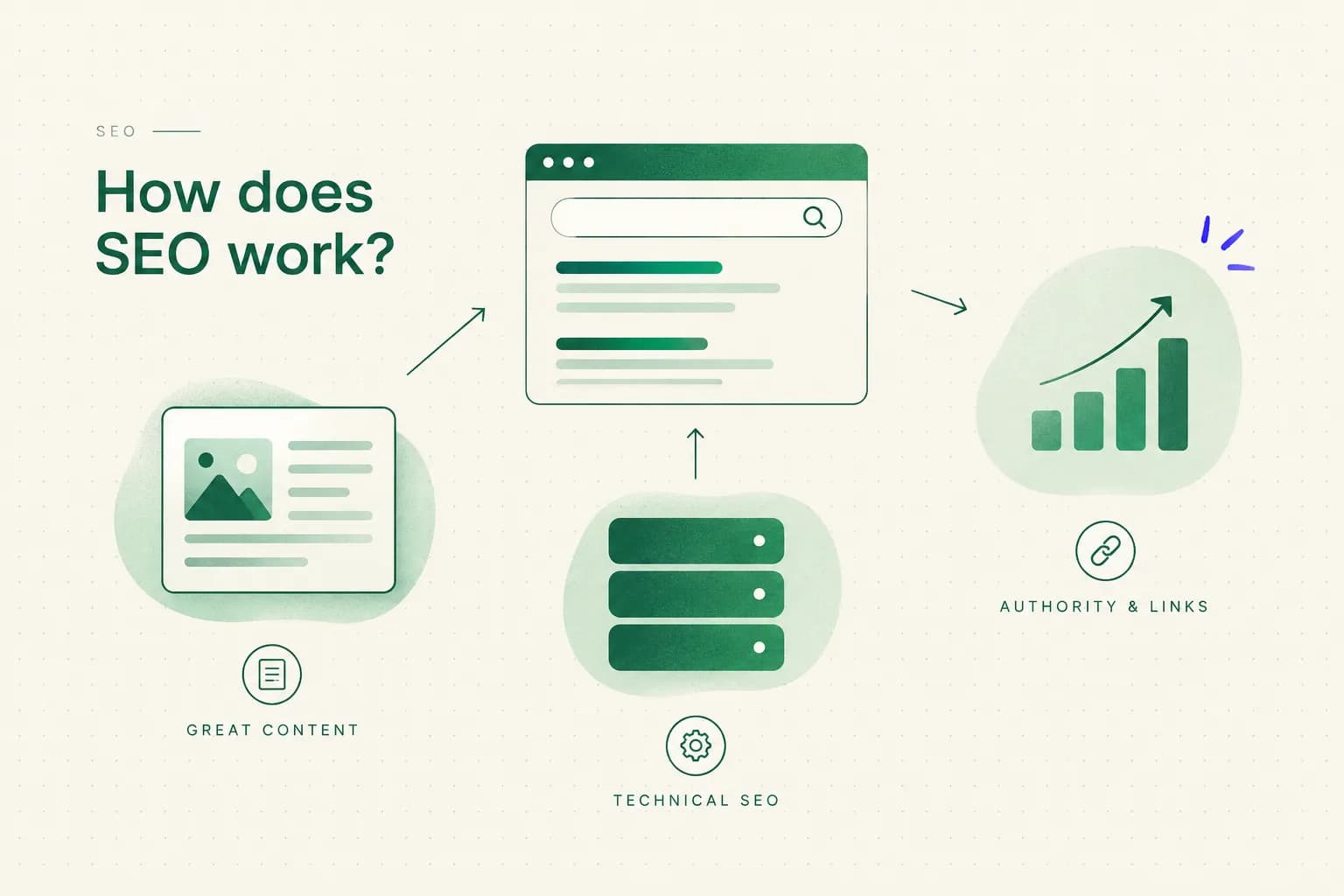
SEO Is a System, Not a Guess
Most people treat SEO like a superstition. Sprinkle keywords here, add some alt text there, cross your fingers, and hope the search engine gods are in a good mood.
That's not how it works.
SEO is a pipeline, and every stage is traceable: a page has to be discoverable, then understandable, then useful, then competitive, and finally connected to something that actually makes you money.
Skip a stage and everything downstream collapses.
A brilliant article that Googlebot can't reach is a diary entry. A perfectly crawlable page about nothing anyone searches for is a very fast way to get zero traffic.
So here's what we're going to do. We'll follow one hypothetical page through the entire system, in the order it actually happens: crawling, indexing, ranking, content, technical health, authority, and measurement.
No jumping ahead.
No "optimize your meta description" advice before we've confirmed the page even exists in Google's index.
And before we start, let's get the honest part out of the way, because most guides quietly skip it.
SEO does not guarantee indexing. It does not guarantee ranking. And it absolutely does not guarantee clicks or sales. What it does is stack the odds, systematically, in your favor.
Anyone promising you a #1 position is either lying or about to do something to your site you'll regret in six months.
Real organic search growth is probability management, not magic.
Ready? Let's follow that page.
How Google Finds and Ranks Your Pages
Here's a fact that surprises almost every beginner: being in Google's index and ranking in Google are completely different things.
Millions of pages are indexed and receive exactly zero visits, forever.
Understanding the three stages separately is the single biggest diagnostic upgrade you can make. Because "my page isn't showing up" has at least three totally different causes, and each needs a different fix.

Crawling Comes First
Crawling is when bots like Googlebot discover and download your URLs. They find pages three main ways: following links from other sites, following your internal navigation, and reading your XML sitemap.
Think of web crawling like a very determined mail carrier who only delivers to addresses someone gave them. If no link points to your page and it's not in the sitemap, that address doesn't exist as far as the carrier is concerned.
You can check crawl activity in Google Search Console under Settings, then Crawl Stats. It shows how many requests Googlebot made, the average response time, and how many requests failed.
Slow responses or a wall of 5xx errors? That's a crawl budget problem, and no amount of clever copywriting fixes it.
Indexing Comes Next
Indexing is Google storing your page and figuring out what it's about. The crawler hands the content over, Google renders it (including JavaScript, usually), extracts the entities and topics, and files it away.
Crawled does not mean indexed.
Google routinely crawls a page and decides, politely, "no thanks." That shows up in Search Console as Crawled, currently not indexed, which is Google's gentle way of saying your page didn't earn shelf space.
Usual culprits: thin content, near-duplicates of pages you already have, or a site with almost no authority yet.
Indexability is earned, not automatic.
To check a specific page, paste the URL into the URL Inspection tool in Search Console. It'll tell you flatly whether the URL is on Google, when it was last crawled, and which canonical URL Google chose.
Quick and dirty alternative: search site:yourdomain.com/your-page.
If nothing comes back, it's not indexed.
(The site: operator is approximate, so treat URL Inspection as the source of truth.)
Ranking Is Not Guaranteed
Ranking is Google scoring every indexed page against one specific query and ordering the results. It happens per query, in milliseconds, every single time someone searches.
This is why a page can sit in the index for four years and never rank for anything useful.
It exists.
It's just not the best answer to any question people actually type.
The search engine results page you see is a live competition, and your page is one entrant among thousands.
Being in the room isn't the same as winning the argument.
So when traffic is flat, ask in order: Is it crawled? Is it indexed? Is it ranking anywhere at all? Each answer points you somewhere completely different.
What Actually Makes a Page Rank
Keyword density died sometime around 2013, and honestly, good riddance. Repeating "best running shoes for flat feet" eleven times never made anyone's page better, it just made it unreadable.
What replaced it is harder to game and far more interesting: Google tries to figure out what you meant, then tries to figure out whether your page delivers it.
Search Intent and Entities
Search intent is the goal behind the query, and it comes in four flavors. Matching it matters more than any on-page tweak you'll ever make.
- Informational: the searcher wants to learn something. "how does seo work," "why is my sourdough flat." They want explanation, not a checkout page.
- Navigational: they want a specific place. "search console login," "rankspiral pricing." You only win these for your own brand.
- Commercial: they're comparing before buying. "best seo tools for small business," "ahrefs vs semrush." Comparison tables and honest pros and cons win here.
- Transactional: they're ready to act. "buy standing desk," "seo audit service." Friction kills these pages faster than anything else.
Put a product page in front of an informational query and it will lose.
Every time.
Not because the page is bad, but because it answers a question nobody asked.
Then there are entities.
Google doesn't just count words, it recognizes concepts and how they relate. Write about "sourdough starter" and Google expects to see hydration, flour type, feeding schedule, and discard, because those concepts genuinely belong together.
That's why thin single-keyword pages underperform.
A 400-word page targeting one phrase signals nothing about topical authority, while a page that naturally covers the surrounding concepts and query variations signals real understanding.
Which brings us to the thing you should stop doing tonight: forcing exact-match phrases into sentences.
"Looking for how does seo work for small business owners in 2026?" reads like a ransom note.
Natural language coverage, where you write the way a knowledgeable person would explain it, hits the variations anyway.
What to Fix First
When a page underperforms, beginners tend to fix whatever they read about most recently. Here's a better filter: classify the problem into one of four buckets, then fix in this order.
- Discovery issue: the page isn't crawled or indexed. Zero impressions in Search Console is the tell. Nothing else matters until this is solved.
- Relevance issue: it's indexed with impressions but ranks 30+. Usually wrong intent match or missing topical coverage. Highest impact per hour of work.
- Authority issue: it ranks 5 to 20 against established competitors. You need internal linking, backlinks, or stronger site-wide credibility. Slower, harder.
- Conversion issue: it ranks well, gets clicks, and nobody does anything. That's a page design and offer problem, not an SEO problem at all.
Notice the order runs from cheapest to most expensive.
Fixing a stray noindex tag takes four minutes. Earning authority takes months.
Start where the leverage is.
Technical Fixes, Links, and Authority

Technical SEO has a reputation for being intimidating, which is a shame, because 90% of the problems that actually hurt sites are embarrassingly simple.
A checkbox someone ticked in 2023.
A plugin that added a tag nobody noticed.
Let's go through the usual suspects, then talk about the two things that build real standing: external authority and internal structure.
Technical Checklist
Work through these in order. Each one can single-handedly keep a good page invisible.
- robots.txt blocks: check yourdomain.com/robots.txt for a
Disallowline covering your pages. A classic disaster is a staging-site rule getting pushed live, quietly hiding entire sections from Googlebot. - Noindex tags: view the page source and search for
noindex. CMS platforms love adding these to category pages, tag archives, and anything built during a "coming soon" phase. URL Inspection will flag it as "Excluded by noindex." - Canonical conflicts: a canonical URL tells Google which version is the real one. If page A canonicals to page B, page A will not rank. Check that every important page canonicals to itself, and that HTTP/HTTPS and www/non-www variants all resolve to one version.
- Missing or stale XML sitemap: your sitemap should list only indexable, canonical, 200-status URLs. Submit it in Search Console and check the coverage report. A sitemap full of redirects and 404s teaches Google to trust it less.
- JavaScript rendering issues: if your content only appears after JavaScript runs, test it with the "View Crawled Page" feature in URL Inspection. If the rendered HTML is empty where your article should be, Google may be seeing an empty page too.
- Redirect chains: A redirects to B redirects to C wastes crawl budget and leaks link value at each hop. Point every redirect directly at the final destination. One hop, maximum.
- Duplicate content: parameter URLs, printer-friendly versions, and near-identical location pages split your signals across clones. Consolidate with canonicals or merge them outright.
- Core Web Vitals: aim for LCP under 2.5 seconds, INP under 200 milliseconds, and CLS under 0.1. These are tiebreakers rather than heavy hitters, but a page that takes six seconds to load loses users long before it loses rankings.
- Structured data: valid schema for articles, products, FAQs, and local businesses helps Google understand your page and can earn rich results. Test it with the Rich Results Test, and never mark up content that isn't visible on the page.
Backlinks That Actually Count
Here's the uncomfortable truth about off-page SEO: the links that move the needle are the ones you can't buy for $40 on a marketplace.
Legitimate authority comes from a handful of durable sources:
- Genuinely useful assets: calculators, templates, comparison tools, free datasets. People link to things that save them work, not to your "5 Tips for Success" post.
- Original research: survey your customers, analyze your own anonymized data, publish the numbers. Journalists and bloggers need statistics to cite, and citations are links.
- Digital PR: expert commentary, reactive quotes on industry news, source platforms where reporters request input. Slow, unglamorous, and remarkably effective.
- Real partnerships: suppliers, clients, industry associations, event sponsorships, guest contributions to publications you'd read anyway.
What doesn't count: link farms, private blog networks, mass directory submissions, comment spam, and reciprocal link swaps. These range from useless to actively penalized, and cleaning them up costs more than earning good links would have.
One strong link from a respected industry publication outperforms two hundred junk links.
It's not close.
Internal Links That Guide Users
Internal linking is the most underused ranking lever available to you, mostly because it's free, requires no outreach, and therefore feels like it shouldn't work.
It works.
The cleanest structure is pillar pages and topic clusters. Here's a concrete example for a site about home coffee brewing:
- The pillar: one comprehensive page, "How to Brew Better Coffee at Home," covering the whole topic at a level that's useful on its own.
- The clusters: 5 to 8 supporting pages going deep on one subtopic each. Grind size, water temperature, pour-over technique, espresso ratios, bean storage, descaling your machine.
- Pillar links down: the pillar links to each cluster page with descriptive anchor text like "how grind size changes extraction," not "click here" or "read more."
- Clusters link up: every cluster page links back to the pillar, usually in the intro or conclusion, using anchor text that describes the pillar's topic.
- Clusters link sideways: where it genuinely helps the reader, cluster pages link to each other. Grind size and espresso ratios belong together.
Two things happen at once.
Crawlers follow those links and infer that these pages form a coherent topic, which strengthens topical authority.
And readers who arrive on a cluster page find the next logical step instead of hitting a dead end and bouncing back to the results page.
Structure and conversion, same lever.
That's rare.
Growing Content Without Breaking It
Most sites don't have a content shortage.
They have a content graveyard: 140 posts, 12 of which get traffic, and a publishing calendar demanding four more per month.
Adding to that pile rarely helps.
Fixing it usually does.
Refresh Before You Publish More
Open Search Console, set the date range to the last three months, and filter for queries where your average position sits between 11 and 30.
Those are page-two rankings.
Pages ranking 11 to 30 are typically one improvement away from page one, and page one is where roughly 95% of clicks live.
You already have relevance and some authority.
You just need a nudge.
The nudge is usually one of four things: updating outdated information, covering a subtopic competitors include and you skipped, adding internal links from your stronger pages, or rewriting the title tag to actually match the query's intent.
Compare the effort.
A content refresh on an existing page might take 90 minutes and show movement within two to four weeks. A brand-new page takes a full day and three to six months before you know if it worked.

This is exactly the problem Rankspiral's Retrolink approach is built around. Instead of treating published posts as finished, it runs weekly checks across existing content to flag ranking slips before they become traffic collapses.
When a post starts sliding, it gets flagged for retrofitting: fresh internal links from newer relevant articles, money links pointed at the right commercial pages, and dead or redirected product links caught before a reader hits a 404. Every change is approval-gated, so nothing edits itself behind your back.
That last part matters more than it sounds.
Automated content changes without human review is how sites quietly wreck pages that were working fine.
While you're auditing, watch for three specific problems:
- Cannibalization: two or more pages competing for the same query, splitting clicks and confusing Google about which to rank. Consolidate into the stronger page and 301 the weaker one.
- Thin pages: 300-word posts with no traffic and no links. Either expand them into something genuinely useful or merge them into a related page. Deleting is a valid option.
- Topical overlap: five posts that each cover 20% of a topic. One consolidated pillar almost always outperforms the scattered version.
What to Measure and When
Traffic is a vanity metric when it's the only metric.
Split your measurement by funnel stage so you know what each number is actually telling you.
| Funnel stage | Metric | What it tells you | Where to find it |
|---|---|---|---|
| Visibility | Impressions and average position | Google sees your page as relevant to queries | Google Search Console |
| Appeal | Click-through rate | Your title and description earn the click | Search Console Performance report |
| Engagement | Qualified organic sessions | Right-fit people arrive and stay | Analytics platform, organic segment |
| Influence | Assisted conversions | Organic touched a conversion path | Attribution or conversion path reports |
| Business impact | Revenue from organic | The only scoreboard that pays salaries | Analytics plus CRM or checkout data |
Now the timelines, honestly segmented, because "SEO takes 6 months" is a useless average of wildly different tasks.
- Technical fixes: days to weeks. Remove a noindex tag and the page can reappear within one crawl cycle.
- Low-competition wins: one to three months. Long-tail queries with weak competitors move fastest.
- Content maturation and topical authority: three to nine months. Clusters need time to accumulate links and engagement signals.
- Competitive commercial terms: six months to two years. If the top results are national brands with 10,000 referring domains, plan accordingly.
Does AI Content Still Rank?
Yes, and also no, and the distinction is the whole ballgame.
Google's stated position hasn't changed: it rewards helpful, original content regardless of how it was produced. What it penalizes is scaled content abuse, meaning mass-produced pages created primarily to manipulate rankings rather than help anyone.
In practice, AI-assisted content that ranks tends to share three traits.
It contains first-party evidence (your data, your screenshots, your customer examples). It's structured clearly enough that both humans and machines can extract answers.
And it says something the other twelve results don't.
This connects directly to E-E-A-T and to how AI Overviews work. Generative answers have to pull from somewhere, and they pull from sources with clear structure, specific claims, and demonstrable experience.
Answer engine optimization is mostly just doing the fundamentals well enough to be quotable.
The ethical line is worth naming: no cloaking, no marking up structured data for content users can't see, no publishing 500 near-identical pages because the tokens were cheap.
These tactics work right up until they catastrophically don't.
Common Questions About How SEO Works
How SEO Works Step by Step
SEO works in five sequential stages: crawl, index, rank, click, convert. Google's bots discover your URL through links and sitemaps, store and interpret the content in the index, score that indexed page against specific queries, present it on the results page where a searcher decides whether to click, and then your page either converts that visitor or doesn't.
Every SEO tactic you've ever read about fits into one of those five stages. When something isn't working, identify which stage is broken before you touch anything else.
How Do You Do SEO for a Website?
Start with technical setup, then intent-led content, then structure. For a brand-new site, the sequence looks like this: verify the site in Google Search Console, submit an XML sitemap, confirm nothing is blocked by robots.txt or noindex, and make sure the site loads quickly on mobile.
Then do keyword research focused on intent rather than volume. Build one pillar page on your core topic, plus five to eight cluster pages on subtopics, and link them together with descriptive anchor text.
Finally, earn a handful of legitimate backlinks through partnerships, original data, or genuinely useful free resources.
That's a complete foundation, and it beats 90% of small sites.
What Are the 4 Types of SEO?
The four types are technical, on-page, off-page, and local SEO.
- Technical SEO makes your site crawlable, indexable, and fast, covering sitemaps, canonicals, rendering, and Core Web Vitals.
- On-page SEO covers everything on the page itself: intent match, topical coverage, headings, titles, internal links, and structured data.
- Off-page SEO is authority built outside your site, primarily backlinks, brand mentions, and digital PR.
- Local SEO targets geography-based queries through your Google Business Profile, local citations, reviews, and location-specific pages.
How Long Does SEO Take to Work?
It depends entirely on what you're fixing, and anyone giving you a single number is guessing.
Technical fixes can show results in days. Low-competition long-tail rankings typically take one to three months.
Content maturation and topical authority take three to nine months, and competitive commercial terms often take six months to two years.
If you already have an established site, refresh existing pages ranking 11 to 30 before applying new-content timelines to your expectations. Those pages can move in two to four weeks, which is a very different planning conversation.
Can I Do SEO Myself?
Absolutely, and the fundamentals are more learnable than the industry likes to admit. Search Console is free, technical audits are mostly checklists, and writing content that matches intent is a skill you can build in a few months of deliberate practice.
Where DIY starts creaking is scale and tracking.
Once you're managing 50+ pages, monitoring rank movements manually, chasing broken links, and remembering which posts need refreshing becomes a part-time job.
That's the point where tooling and automated monitoring earn their cost.
Does SEO Still Work in 2026?
Yes, and the reason is structural: AI answers need sources. Every AI Overview, chatbot response, and generative summary is built by pulling from indexed web content, which means someone has to be the original, credible, citable source those systems reference.
What has changed is the payoff distribution.
Generic content that restates what everyone else says gets summarized away without a click. Content with original data, genuine experience, and clear structure gets cited and clicked.
The bar moved up.
The game didn't end.
Where to Start Tonight
Let's compress everything into a decision.
If your site is brand new: technical setup first.
Search Console verified, sitemap submitted, nothing accidentally blocked.
Then one pillar page on the topic you most want to be known for.
That's your evening.
If your site is established but flat: do not write a new post.
Open Search Console, filter for positions 11 to 30, and list every page sitting on page two.
Those are your quickest wins, and you already paid for them.
If you're somewhere in between: audit what exists, consolidate the overlap, then build clusters around whatever's already working.
Now the one concrete action, and it takes about fifteen minutes.
Pick a single underperforming page tonight.
Before you edit a word, diagnose which of the four problems it has: discovery, relevance, authority, or conversion. Check the index status, check the impressions, check the position, check whether clicks convert.
Most people skip the diagnosis and go straight to rewriting.
Then they wonder why six hours of work changed nothing... because the page had a noindex tag the whole time.
Diagnose first.
Fix second.
That's the entire system.